
What A Good Photograph Really Looks Like (And Who Decides)
Updated 14 Oct 2026
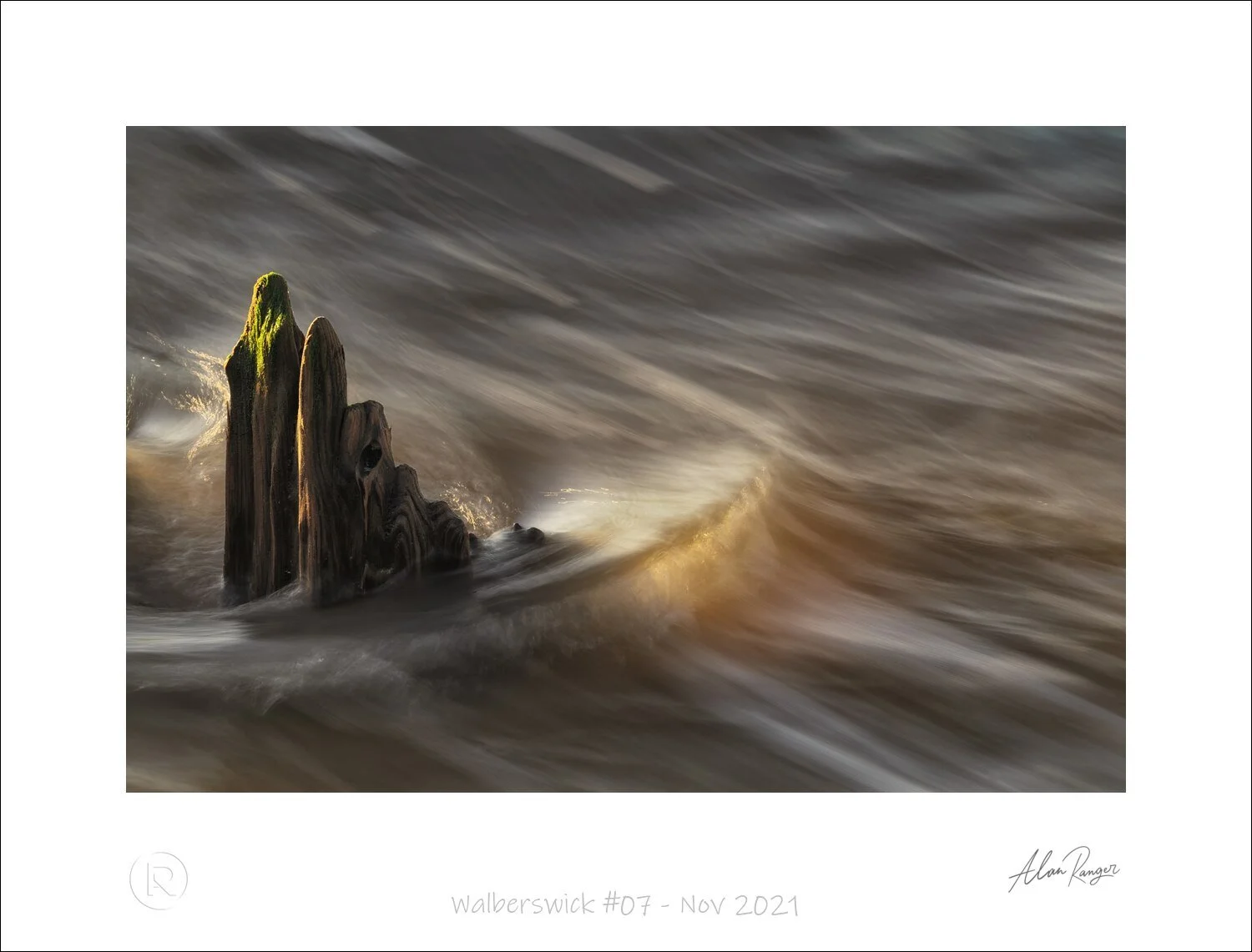
Table of Contents Show
Last month I wrote about the danger of pressing the shutter too soon — how the photograph you're chasing usually arrives, if you're still enough to let it come. This month I want to talk about the danger at the other end of the same process: not knowing when to put the mouse down.
Here's a scene I've watched play out a hundred times — and I've played it out myself more than I'd care to admit.
A photographer sits at their computer. They've been editing a photograph for the better part of an hour. It looks pretty good. Maybe. They've pulled the shadows, lifted the highlights, tuned the whites, warmed the temperature by a hundred kelvin, cooled it back by fifty, brought in a graduated filter on the sky, taken it back out, nudged the vibrance, decided the vibrance was too much, dropped it back down.
They save it. They stare at it. They wonder if the sky is now too dramatic. They open Instagram to compare. They come back to Lightroom. They move a slider.
You know this scene. Everybody who has ever edited a photograph on a computer knows this scene. And most of us are quietly convinced the problem — the reason we can't quite finish — is technical. That we don't yet know Lightroom well enough. That we haven't watched enough tutorials on masks. That the next preset pack is the one that will finally give us the look.
It isn't. The reason you can't finish is much harder to admit than that.
The honest version
What a good photograph isn't: editing for the wrong audience
Here's the honest truth about why most editing sessions never finish: you're not editing for yourself. You're editing for the last comment you got on the last photograph you posted. Or for the judge who threw you out of the club competition three weeks ago. Or for the version of yourself you imagine you'd be if only this photograph looked more like the ones that go viral.
That's not editing. That's outsourcing.
Every slider you move in that state is a small negotiation with an audience that isn't in the room.
An audience whose taste you've often never properly interrogated. Instagram's algorithm doesn't have a philosophy of photography — it has an engagement model, and it doesn't care whether you agree with it. Camera-club judges have opinions, but they aren't your opinions, and they change from month to month. Popular commenters mean well, but they are, more often than not, saying whatever comes to mind — and what comes to mind is rarely the same thing as what's true about your picture.
If you're editing to please any of them, you will never be finished. Because they'll never agree with each other, they'll never stop moving, and every one of them will pull you in a different direction the moment you post the next thing.
The real reason
You don't know when to stop because you don't know what you think
The reason your finish line keeps moving isn't that you lack technique. It isn't that you don't understand histograms, or masks, or graduated filters. It's that you've never done the harder work upstream:
If you had — if you'd sat with it for a moment before touching a slider and asked yourself "what does this picture do that I care about? what am I trying to protect? what would ruin it?" — you'd know when to stop. Not by feel. By reference to a standard you had already set.
Instead, you edit until someone tells you it's good. And the moment they do, you notice they haven't quite seen the thing you were trying to do — so you edit some more, hoping the next round will make it obvious.
Your photograph isn't finished. You just gave up.
The absence of an internal standard is the cause of the infinite edit. It isn't that we over-process. It's that we process without knowing what "enough" would even look like — because we've never asked the question.
The framework behind it
Judgement: the fourth quadrant of the Composition Framework
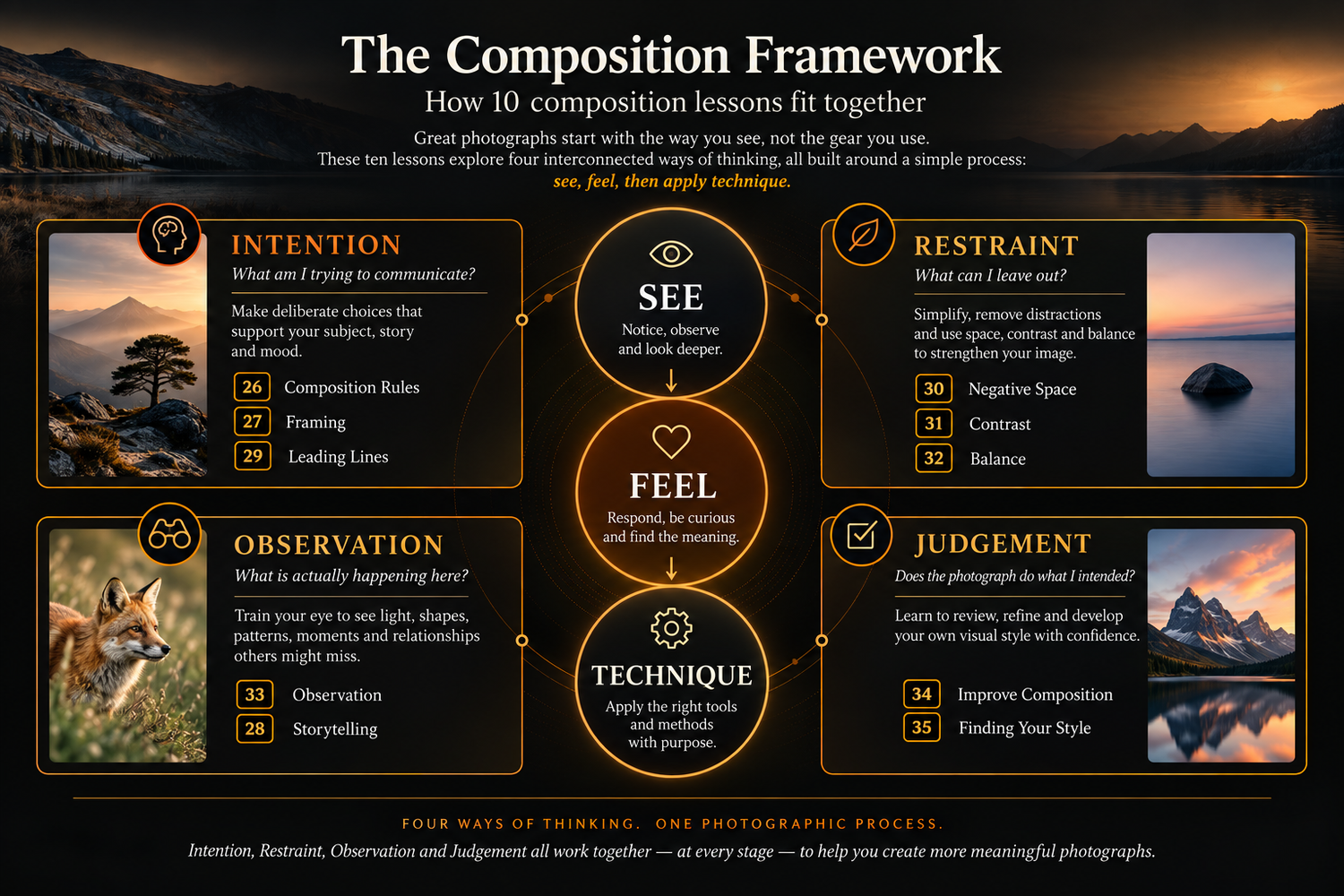
Everything I teach about composition sits inside one four-quadrant framework — and it's worth saying out loud where this piece lives, because it's not an accident that the "when do I stop editing?" problem keeps coming back.
The four quadrants are Intention (what do you want the viewer to feel?), Restraint (what do you leave out?), Observation (what are you actually looking at?), and Judgement (what makes a good photograph — yours, not someone else's?).
The reason the sliders never settle isn't technical. It's that we never built the fourth muscle. We built the first three — intention when we chose the location, restraint when we composed, observation when we waited — and then we handed the fourth to Instagram, the camera club, or the next tutorial.
Judgement is the quadrant that stays yours. Below is the whole framework, so you can see how the pieces fit — and so that next time the slider refuses to settle, you know which muscle to go and train.
Practise it
What this looks like on a Tuesday
Next time you sit down to edit a photograph, try this.
- Before you move a single slider, write one sentence — in a notepad, in your head, on the back of a receipt: "What I love about this picture is _______." Fill it in honestly. Not what you think you should love. Not what will get likes. What you actually respond to when you look at it.
- Every time you're about to move a slider, ask one question: "does this move protect that thing, or does it obscure it?" If it protects it, make the move. If it doesn't, don't.
- When the sentence is satisfied, stop. Not when it's "a bit better". Not when it matches what someone else posted this week. When the sentence you wrote is honoured, close Lightroom.
You will edit less. You will edit faster. And — more importantly — you will know when you're done, because the sentence you wrote is the standard the picture had to meet. It will either meet it or it won't. If it does, close Lightroom. If it doesn't, the answer probably isn't more editing.
Where this fits
Owning what you think — the discipline that keeps showing up
Owning what you think — rather than outsourcing it — is a discipline that shows up wherever we hand our judgement over to something else. The camera, the location, the audience, the finish line: each of them a place where we could decide for ourselves, and each of them a place where most photographers quietly wait for permission.
This piece closes a three-issue arc on the discipline of trust — three places on the photographic act itself: inside the frame (Issue 3 on emptiness), before it (Issue 4 on waiting), and after it (this one, on knowing when to release).
The next three editions take the same discipline into wider territory: Issue 6 on the gear you carry, Issue 7 on the places you go, and Issue 8 on the people whose opinions you weigh. Each of them, I think, a place where photographers hand over a decision they should own.
"A photograph is never truly finished, only released."
— A principle often distilled from Ansel Adams
There's a certain grace in that. It says the finish line was always somewhere behind you. What you were doing at the end wasn't finishing — it was refusing to release.
Release your photograph. If it wasn't good enough, the next one will be better for the practice. If it was good enough, you'll know before anyone tells you.
Where to go next
Practise defining a good photograph
If this piece has landed, here's where to take the idea next on the site.
- The free Academy foundation course — 60 modules that start with seeing, not with settings. The practice of deciding what you think, built step by step.
- One-to-one tuition — bring your own frames. We work on what you wanted the picture to do, and whether the edit protected it.
- RPS mentoring — if you're ready to argue for a body of work in front of a panel, this is where you build the standards it will have to meet.
- My landscape workshops — small groups, slow pace, with time at the end to sit with what you captured and ask the honest question.
- ← Previous issue: The Art of Slow Photography — the companion piece on before the frame. This one closes the arc.
About the image
Walberswick, Suffolk — November 2021
From my Water Abstracts series. An old sea defence, worn by the decades of tide it has stood against, becomes the still centre of a frame carried otherwise by moving light and silked water. The wood doesn't perform — it simply is. It's the picture I've been carrying around while writing this piece, because the post doesn't need the water's approval to keep standing. Neither does your photograph.