
UK Street Photography: An Ethics-First Practical Guide
UK Street Photography: An Ethics-First Practical Guide
Table of Contents Show
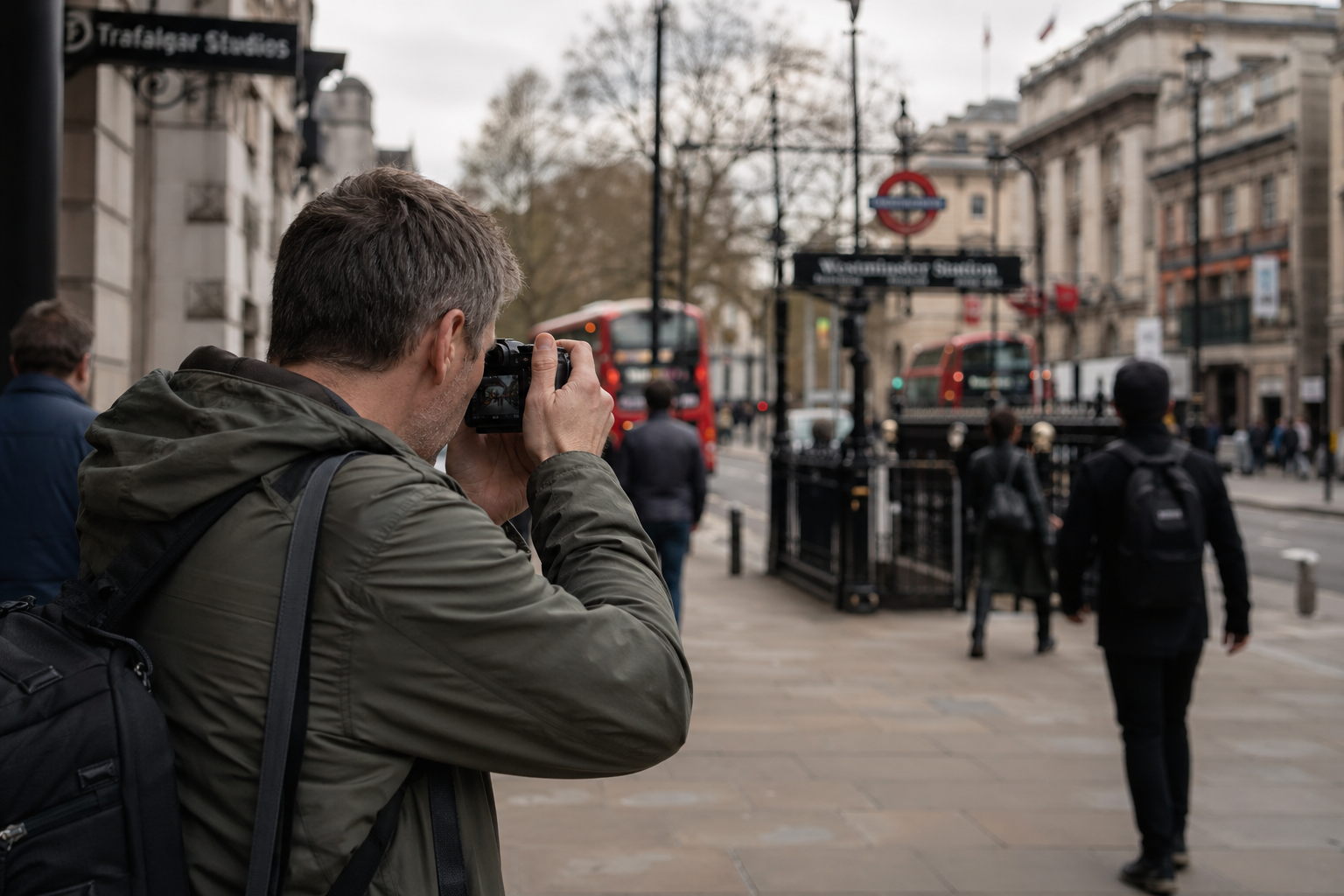
UK street photography sits in an unusual position relative to most other photographic genres. The legal floor is genuinely generous — public-place photography is lawful, no model release is needed for editorial use, and the historic "anti-terrorism" stop-and-search panic that briefly made street photographers nervous in the 2010s has largely faded. The technical floor is low — a single camera body, one prime lens, no tripod, minimal kit. The genre is accessible to anyone with a camera and a working pavement. So why does most UK street photography fail to land?
The answer isn't legal, and it isn't technical. It's ethical. The interesting question for the modern UK street photographer isn't "is this legal?" — almost always the answer is yes. The interesting question is "I can, but should I?" That's the layer where the strongest street work distinguishes itself from the work that just happens to be legal. This guide leads with that ethical layer because, in my experience, it's where most amateur street photographers either freeze entirely (uncertain about the rules and unwilling to risk a confrontation) or charge in unthinkingly (knowing they're legally fine and assuming that's the end of it). Neither produces strong, sustainable work.
This article is the ethics-first companion to my street photography master guide (broader fundamentals) and my photographers' rights in the UK (the legal layer in detail). Both are useful foundations. This piece sits above them: the four UK street shot types, what UK law actually says (in plain English), the can-vs-should decision framework, and the practical situations where the law and the ethics diverge.
Why street photography is harder than it looks
On paper, street photography should be the easiest genre. The subject is everywhere. The kit is minimal. The conditions vary but rarely prevent the work. Yet most amateur street photographers I've taught either give up after a few sessions of frozen indecision, or produce a stream of frames that feel intrusive without quite understanding why. Three things make street harder than it looks:
The subject doesn't want to be the subject. Unlike a landscape (which doesn't have feelings) or a portrait (where the subject has consented and posed), the street subject is a stranger going about their day who hasn't agreed to anything. You're capturing them anyway. The ethical weight of that decision is real, even if the legal weight is zero.
The window is fractional. The "decisive moment" Cartier-Bresson named is genuine — strong street frames typically resolve and dissolve within one or two seconds. There's no time to think through a composition and check it twice. The decisions have to be pre-loaded so the moment can be reacted to.
The line between strong work and intrusive work is thin and personal. What counts as a respectful street frame to one photographer counts as a violation to another. There's no universal standard. Each photographer ends up with their own personal ethical code — and the photographers who work consistently for years are the ones who've thought it through deliberately rather than letting it stay vague.
The frameworks below are designed to load the decisions in advance — the four shot types, the legal layer, the ethical decisions — so that on the street, when the moment opens, you're free to react rather than having to think.
The four UK street photography shot types
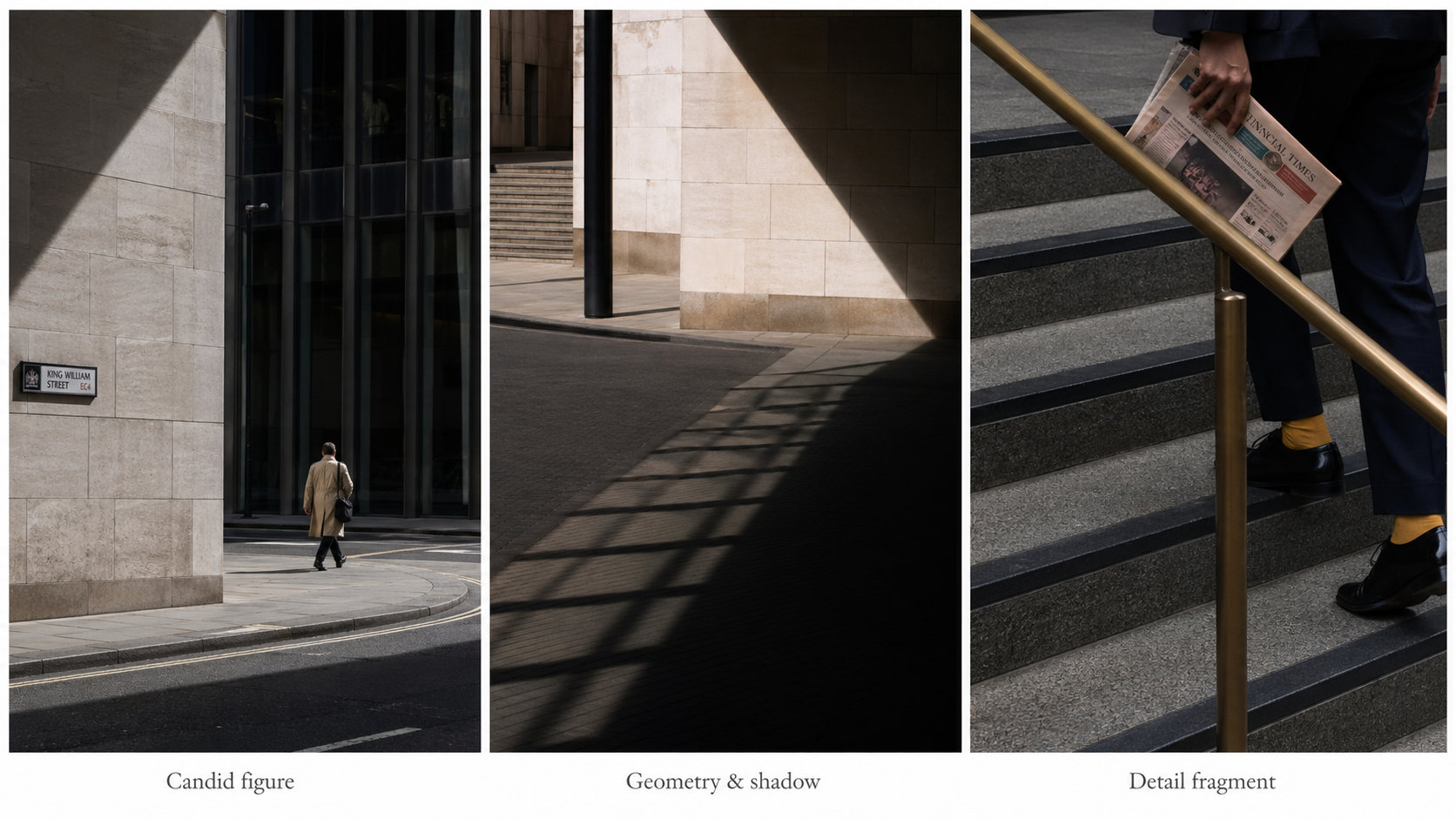
Productive UK street photographs almost always fit one of four shot types. Same Applied Learning shot-type framework I use elsewhere — pick one or two per session, commit, work them deliberately rather than chasing every type at once.
The four UK street photography shot types — different ethical weights, different focal lengths, different mindsets. Pick one or two per session and commit; don't chase all four at once.
The four shot types overlap in practice — a strong street frame might combine candid people with urban geometry — but each one rewards a different mindset, a different focal length, and a different ethical posture. The candid-people shot type carries the highest ethical weight; the urban-geometry-and-architecture shot type carries almost none (it ties directly into architectural exterior photography with people incidentally in frame); the detail-fragment shot type sits between; the decisive-moment shot type is the hardest because it demands all of the above simultaneously.
What UK law actually says
UK street photography law is more permissive than many photographers assume, and more complicated in specific cases than most quick-summary articles let on. The plain-English version:
UK street photography law in plain English — practical positions on the most common situations. This is general guidance not formal legal advice; for the full detail see Alan's photographers' rights guide linked in the article.
General guidance only — not formal legal advice. UK law applies; rules differ in France, Germany, Hungary, and many other countries. See the linked photographers' rights guide for detail.
The headline summary: in England, Scotland, Wales, and Northern Ireland, you can photograph people in public places without their consent for editorial, artistic, and personal use. You don't need a model release. You don't need permission. The historic "anti-terrorism" Section 44 stop-and-search misuse that briefly made photographers nervous was challenged in court (Gillan and Quinton v United Kingdom) and the police powers were narrowed. For the full legal layer in detail — including the breastfeeding amendment to the Sexual Offences Act, harassment thresholds, and private-but-publicly-accessible spaces — see my photographers' rights in the UK guide. For copyright and image-use questions after capture see my copyright and digital images guide.
The most important practical points: (1) don't photograph people in places where they have a reasonable expectation of privacy (looking through a house window from the street is not the same as photographing them on the pavement); (2) photographing children is legal but ethically charged — see the next section; (3) "private but publicly accessible" spaces (Canary Wharf, Covent Garden, More London, parts of South Bank, many shopping centres) are legally treated as private property where you can be asked to stop; (4) commercial use of images of identifiable people may require model releases regardless of where they were taken.
The ethics-first framework — can vs should
This is the layer the genre's strongest practitioners think most about and the layer most beginner guides skip. The premise: in the UK, "can I take this photograph?" is almost always yes. The interesting question is "should I?" My personal framework, refined across years of teaching this and shaped by my own ethical policy, is the six decisions below — three before pressing the shutter, three after.
None of these decisions has a universal right answer. Different photographers will reach different conclusions on the same situation, and that's fine — the key is to have made the decisions deliberately rather than to have stumbled through them. Photographers who've thought through their own ethical code can work the street confidently for years. Photographers who haven't tend to either freeze or burn out.
Common ethical situations and the right response
The framework above is general; the situations on the street are specific. Most UK street photographers encounter the same recurring scenarios. Practical positions on each:
Homeless people. My position, and the position of most thoughtful UK street photographers I respect, is no. The street is their home; photographing them is the equivalent of standing in someone's living room and pointing a camera. Their lack of housing doesn't make their dignity public. There are exceptions — explicit consent given freely, or photographs that genuinely document homelessness as an issue with informed engagement — but the default is no.
Children. Legal but ethically charged. My position: never as identifiable subjects, never alone in frame as the focus. Children appear in my street work only as part of a wider scene where they're not the identifiable subject — silhouettes within a larger composition, blurred motion within a busy scene, or incidental to the frame's actual subject. If a parent or carer notices and asks what you're doing, the right answer is honest, calm, and to delete if asked.
Vulnerable adults. Same default as homeless people — no. People visibly intoxicated, distressed, in medical crisis, or otherwise not in a position to engage with a stranger pointing a camera. The frame might be visually compelling; that doesn't make it ethical.
Religious dress, ethnic markers, disability. The question is whether you're photographing a person who happens to wear/have/be those things, or whether you're photographing those things through a person. The first is fine; the second isn't. A useful test: would the frame work if the religious/ethnic/disability marker were absent? If yes, you're photographing a person; if no, you're using them as a visual prop.
People in distress, arguments, public emotional moments. Default no, even when legally fine. The "decisive moment" can be a moment of human pain, and capturing it without engagement is intrusive even if it's powerful.
Tourists, performers, and people who are clearly performing for the public. Buskers, street performers, costumed entertainers, tourists actively posing for their own photos — much lower ethical weight. They've already made themselves visible to the public eye in a way the average passer-by hasn't. (Tipping a busker if you photograph them is good practice and good etiquette.)
Being challenged or asked what you're doing. Stay calm. Be honest. Explain you're a street photographer, working on personal/artistic photographs of public life. Show the frame if asked. If they ask you to delete it, delete it — even if the law says you don't have to. The memory of a confrontation is worse than the loss of any single photograph, and the next person might be more receptive when you're feeling calm rather than rattled.
When to engage and ask permission. Some street photographers ask before shooting, some after, some never. All three approaches are legitimate. Asking after produces more candid work but invites refusal; asking before produces less candid work but builds rapport. The strongest practitioners I know use both depending on the situation — spontaneous reactive frames without engagement, and intentional approached portraits with permission.
Kit and approach for UK street work
Street photography rewards minimalism and punishes over-equipment. The standard kit:
One camera body, ideally small, quiet, and unobtrusive. Mirrorless cameras have transformed this — silent electronic shutters mean no shutter slap to alert the subject. A discreet black body without obvious branding works better than a chunky white-lensed setup that screams "photographer."
One prime lens, 28mm or 35mm equivalent. 28mm forces you closer and produces more contextual frames; 35mm is the classic Cartier-Bresson focal length and works for both candid people and architectural-tie-in shots. Avoid telephotos for street — shooting strangers from 70-200mm at distance is the photographic equivalent of shouting from across the street; it's disrespectful even when legal.
No tripod. Street is handheld by nature. Tripods slow you down, mark you as a photographer rather than a citizen, and shift the encounter from "person noticing a stranger" to "person noticing a deliberate setup."
Aperture priority or fully manual, depending on stable light conditions. Pre-set aperture (f/8 typical), shutter speed minimum 1/250 to freeze pedestrian motion, Auto ISO with a sensible upper limit. The camera should be ready before the moment opens.
For broader practical technique — composition, working close, blending in, shooting from the hip versus through the viewfinder — see my street photography tips article. For a structured field assignment to apply this framework see my street photography practice assignment.
A UK street photographer on law and ethics
The video below — "Law and Ethics in Street Photography" by Sean Tucker on the Sean Tucker channel — is an extended interview with Nick Dunmur from the Association of Photographers (AOP) legal team, covering the UK legal position on street photography in detail and Sean's own thoughts on the personal ethical code that sits above the law. The framing — "sometimes asking if you 'can' take a photograph isn't enough, you also need to ask yourself whether you 'should'" — is exactly the thesis of this article. Strongly recommended viewing before your next serious street session.
Common UK street photography mistakes
Treating the legal layer as the only layer. "It's legal" isn't an argument for taking every photograph the law permits. It's a floor, not a ceiling.
Working the wrong focal length. Telephoto street photography from 50 metres away is rarely the strongest work. Closer is harder but more honest, and produces frames where the photographer's relationship to the subject is implicit in the composition.
Shooting from the hip without intent. Hip-level shooting is a legitimate technique for unobtrusive candid work. It's also frequently used as an excuse for not committing to compositions. Strong hip-shot frames are deliberate; lazy hip-shot frames are obvious.
Photographing the easy emotional moments. Tears, anger, distress, arguments — the visually compelling moments are often the least ethically defensible to capture. Strong street work doesn't require human pain as its raw material.
Confusing intrusion for intimacy. Standing close enough that the subject definitely notices, framing in a way that makes them uncomfortable, and pressing the shutter anyway is intrusion, not intimacy. Real intimacy in street work usually requires either consent or genuine spontaneous unawareness — not the in-between.
Pretending you're not a photographer when challenged. Lying about what you're doing makes it worse. Honest, calm, brief explanation works far more often than people expect.
Forgetting that "private but publicly accessible" spaces have rules. Canary Wharf, Covent Garden Piazza, More London, the South Bank near the Royal Festival Hall, most shopping centres — security can ask you to stop. Argue politely if you wish; comply when pushed.
Posting recognisable people online without thought. Just because the law allows publication doesn't mean every social media post is a good idea. Subjects sometimes find their own street portraits years later — anonymous-feeling on the day of capture, identifiable when the algorithm serves it back to their workplace.
UK street photography FAQ
The legal floor is generous; the interesting question is ethical. "Can I?" is almost always yes. "Should I?" is the question worth asking.
Pick one or two of the four shot types per session — candid people, urban geometry, detail fragment, or decisive moment. Don't chase all four at once.
Load the decisions in advance. Pre-set kit, pre-set ethics, pre-set focal length and exposure — so on the street you can react rather than think.
Default no on homeless people, vulnerable adults, identifiable children, people in distress. The frame might be legal and visually strong; that doesn't make it ethical.
Work close with a 28mm or 35mm prime. Telephoto street photography from distance is rarely the strongest work — and it's often less honest than close engagement.
If challenged, stay calm and honest. Explain what you're doing. Show the frame if asked. Delete if asked, even though you don't have to.
Develop your own ethical code deliberately. Photographers who've thought it through work the street confidently for years; those who haven't tend to freeze or burn out.
Continue learning
Conclusion and summary
UK street photography is one of the most legally generous and ethically demanding genres in photography. The law gives you wide latitude — public-place photography of strangers is lawful, no model release is needed for editorial use, the historic stop-and-search panic has largely faded — but the law isn't the floor of good practice; it's the floor of permitted practice. The strongest UK street photographers work above the legal floor, on a self-imposed ethical layer that excludes more frames than the law would. That's not a limitation of the work; it's part of what makes the work worth making.
The framework to internalise: four shot types as a decision before you arrive (candid people, urban geometry, detail fragment, or decisive moment); the legal layer settled in the background so you're not anxious about it; the can-vs-should ethical layer worked through deliberately so the in-the-moment decisions are pre-loaded; one camera body, one 28mm or 35mm prime, no tripod, working close and honestly. Default no on the situations where the ethical weight is highest — homeless people, identifiable children, vulnerable adults, people in genuine emotional distress — even when the law would permit. Stay calm and honest if challenged; delete if asked even though you don't have to. None of this requires extra equipment; all of it requires the willingness to think before pressing the shutter.
If you'd like to develop street photography under structured 1-to-1 guidance with someone who can review your work and help you build your own ethical code, my private photography lessons are the natural fit — street photography is genuinely teachable in your home city with your own camera and your own pavements, and a 1-on-1 session can transform tentative work into confident, sustainable practice in a way generic advice can't. For ongoing structured assignments and image review including street as a topic, my monthly mentoring with assignments service is the longer-term option — flexible monthly subscription with a new assignment each month and one-to-one review of your three submitted images. Across more than twenty years of professional photography teaching, the photographers I've watched develop strong street work fastest are the ones who stopped worrying about the legal layer and started thinking deliberately about the ethical one. The framework is the starting point. The pavements are the practice. The decisions are what produce work worth making.