
Photography Teaching: Why Most Of It Has It Backwards
Updated 13 Oct 2026
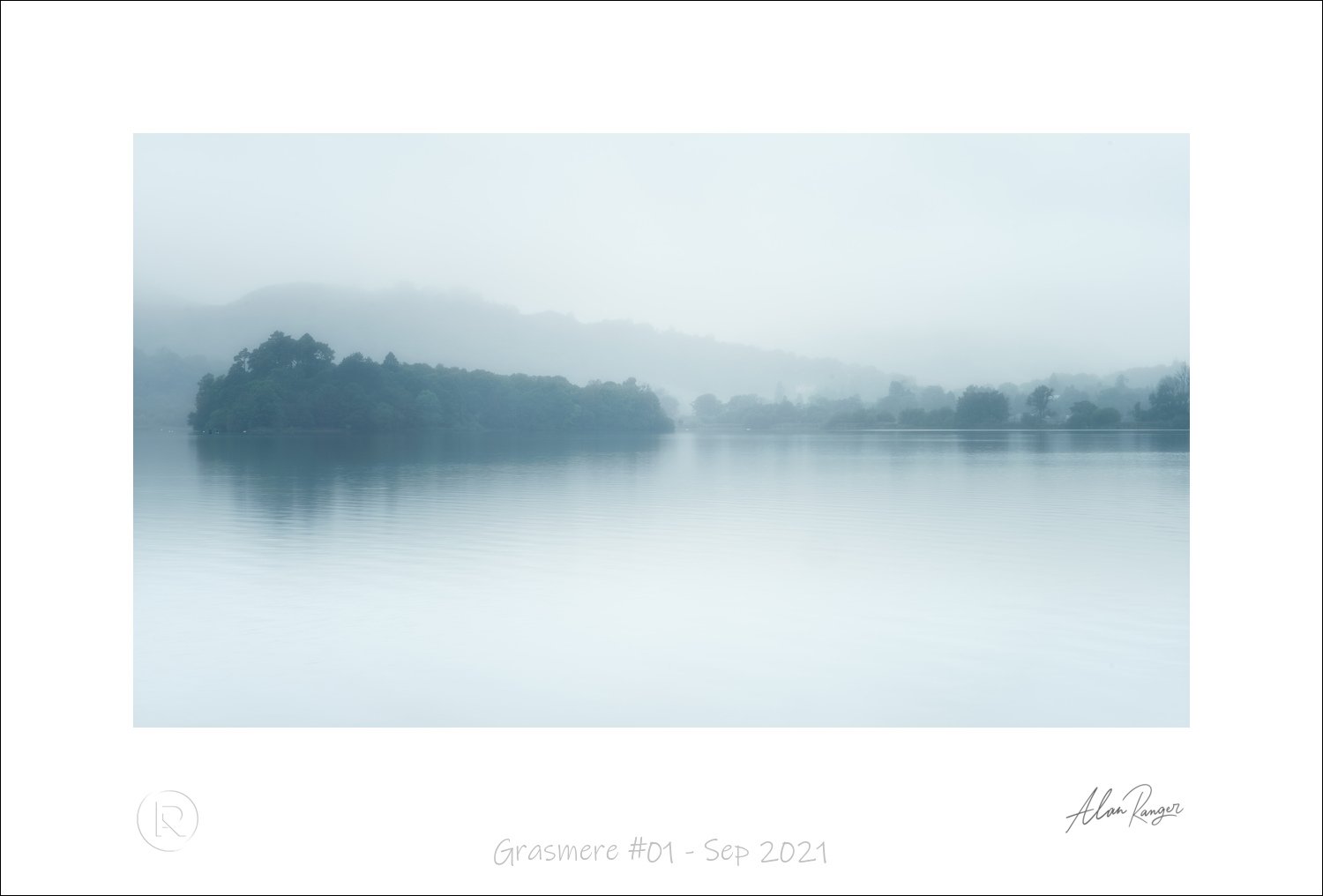
Table of Contents Show
I've taught photography for more than twenty years — beginners through advanced, in evening classes in Coventry and on workshops from Snowdonia to the Scottish Highlands. Over a thousand evening classes. More than five hundred location workshops. Two years lecturing at the Xposure International Photography Festival in Sharjah, sharing the bill with photographers I'd admired all my life — Don McCullin, Steve McCurry, Sebastião Salgado. And I've come to a conclusion I'd have argued against when I started teaching: most photography teaching is in the wrong order.
We teach the camera before we teach seeing. We teach exposure before we teach intention. We hand new photographers a rulebook — rule of thirds, leading lines, golden ratio — before we ever ask them why they wanted to lift the camera in the first place. And then we wonder why so much modern photography feels technically correct and emotionally flat.
The problem
How photography teaching lost its sequence
There has never been a better time to learn the technical side of photography. YouTube tutorials, exposure cheat-sheets, histogram explainers, infinite gear reviews.
A keen beginner today has access to more information than a working photographer had twenty years ago. And yet I see the same pattern, week after week, in the people who come to me already months or years into their journey: technically capable, creatively becalmed. They know what to do with the camera. They don't know what to do with themselves.
Composition rules are training wheels — and most photographers never take them off.
The rule of thirds, leading lines, foreground-midground-background — these aren't destinations. They're scaffolding to support beginners until they can hold the frame on their own. But because they're easy to teach and easy to grade, they've become the syllabus. We've started treating the scaffolding as the building.
The cost is a generation of photographers making pictures that look like other people's pictures. Competent imitations of someone else's blueprint. Influence and inspiration are fine for a while — but you can't grow beyond technique if you're working from someone else's eyes.
The shift
Stop chasing settings. Start chasing feeling.
On almost every workshop I run, in the first half hour, someone will ask me: what aperture should I use for this shot?
It's the wrong question. Or rather, it's the right question asked at the wrong moment. The answer to what aperture depends entirely on what you're trying to say. And most photographers, at that point in the morning, haven't yet stopped to ask themselves what they're trying to say.
The sequence I teach, every time
They've stopped at a place because it looks photogenic. They've raised the camera because that's what you do when you've travelled somewhere with one. And now they're searching the settings menu for an answer that isn't in the settings menu.
The shift I try to teach — and it's one I find myself returning to in every workshop, every mentoring session, every evening class — is this: the photograph starts before the camera comes up. It starts when you stop and notice what made you stop. It starts when you name the feeling, not the subject. Then you choose the lens, the position, the exposure.
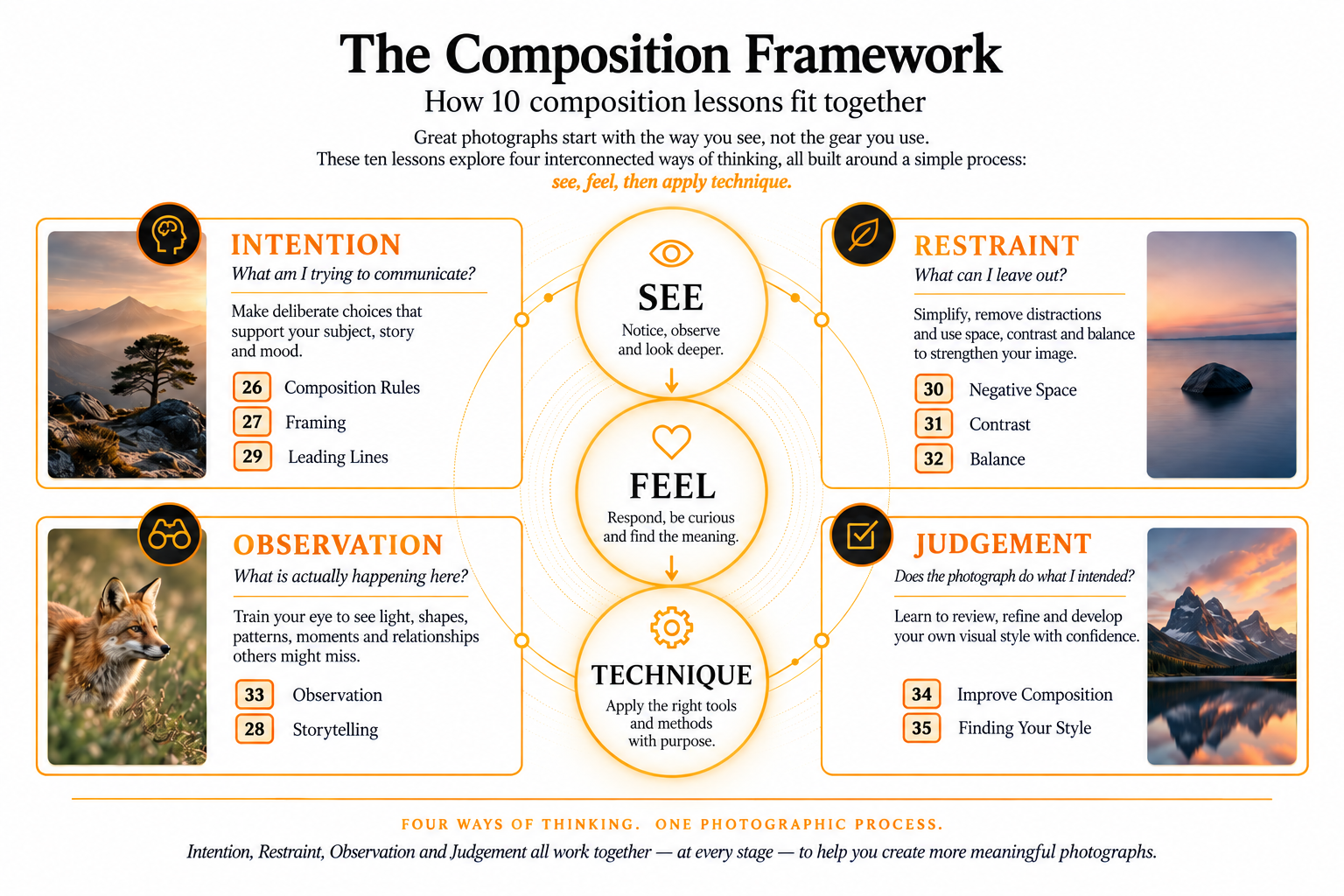
I've written elsewhere about a structured way to approach this — the Composition Framework I teach in the Academy.
"There will always be those who look only at technique, who ask 'how', while others of a more curious nature will ask 'why'. Personally, I have always preferred inspiration to information." — Man Ray
The counter-argument
This isn't anti-technique
If you've read this far and concluded I'm saying don't bother learning your camera, you've misread me. Technical fluency matters. It's what stops a feeling becoming a missed shot. If you can't reach the right aperture quickly, or you don't know how your camera meters a backlit scene, the picture you saw in your head never reaches the card. The technical side has to be there.
Technique is a means, not an end. When the sequence is right — intention first, technique second — the technical learning actually accelerates, because it suddenly has somewhere to go. Students who've drifted for years stop drifting. They have a question the camera can finally answer.
This is the Logic part of Light & Logic earning its keep. There's nothing romantic about flailing around with no technical control. There's also nothing useful about technical control with nothing to say.
The framework
The Composition Framework
The practice
What this looks like on a Tuesday
If you want to try something this week, try this. Next time you go out with a camera, don't lift it for the first five minutes.
- Walk. Look. Notice what makes you stop.
- Before any setting decision, ask yourself: what is the feeling I want the picture to carry? Not what is this thing — what is this feeling. Loneliness? Stillness? The end of something? The beginning of something?
- Only then — choose the lens, the position, the exposure that will deliver it.
Most photographers reverse this. They reach for the camera first and look for a feeling to justify it afterwards. Reversing it back is the single biggest shift I see in the people I teach. It changes their pictures, but more interestingly, it changes how they walk through a landscape. They stop hunting and start seeing.
Where to go next
Where to take this further
Light & Logic explores this territory once a month — the place where technique and intention meet, where craft serves feeling, where the why of a photograph leads the how. It's for photographers who want to understand why their pictures work, not just how to take them. No upselling, no hot takes on gear, no rehashing of YouTube tutorials.
If any of this has resonated and you'd like to work the shift in a structured way, three places to go next:
- The free Academy foundation course walks you through the Composition Framework from the ground up.
- My landscape workshops put the sequence into practice in the field, with me alongside you.
- One-to-one tuition is where we unpick where your own sequence has drifted and rebuild it around what you actually want to say.
If you disagree with any of this — particularly if you teach photography and think I've got it wrong — I want to hear it. Reply, comment, push back. We'll have the argument out properly.
About the image
Grasmere, September 2021 — Ma / Amor Vacuii
From my Ma — Amor Vacuii series. Ma is the Japanese concept of negative space — the meaningful pause, the room to breathe. Amor Vacuii is Latin for a love of emptiness, the deliberate opposite of horror vacui: the artist's instinct to fill every square inch. This photograph is what happens when you stop trying to fill the frame and let the space be the subject.