How to Plan an LRPS Panel: A Practical Guide for 2026
Table of Contents Show
How to Plan an LRPS Panel: Choosing and Testing Your Ten Images
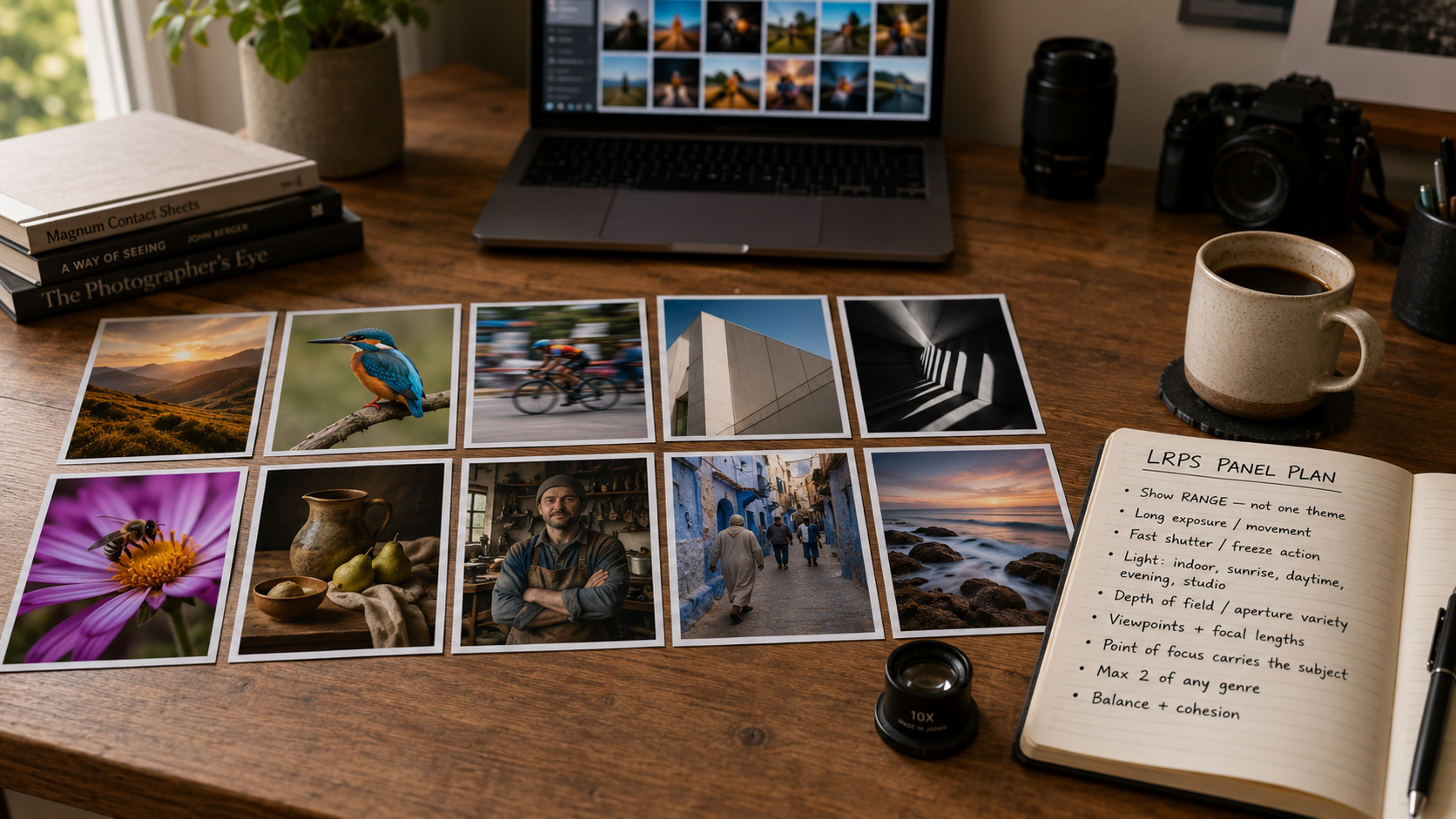
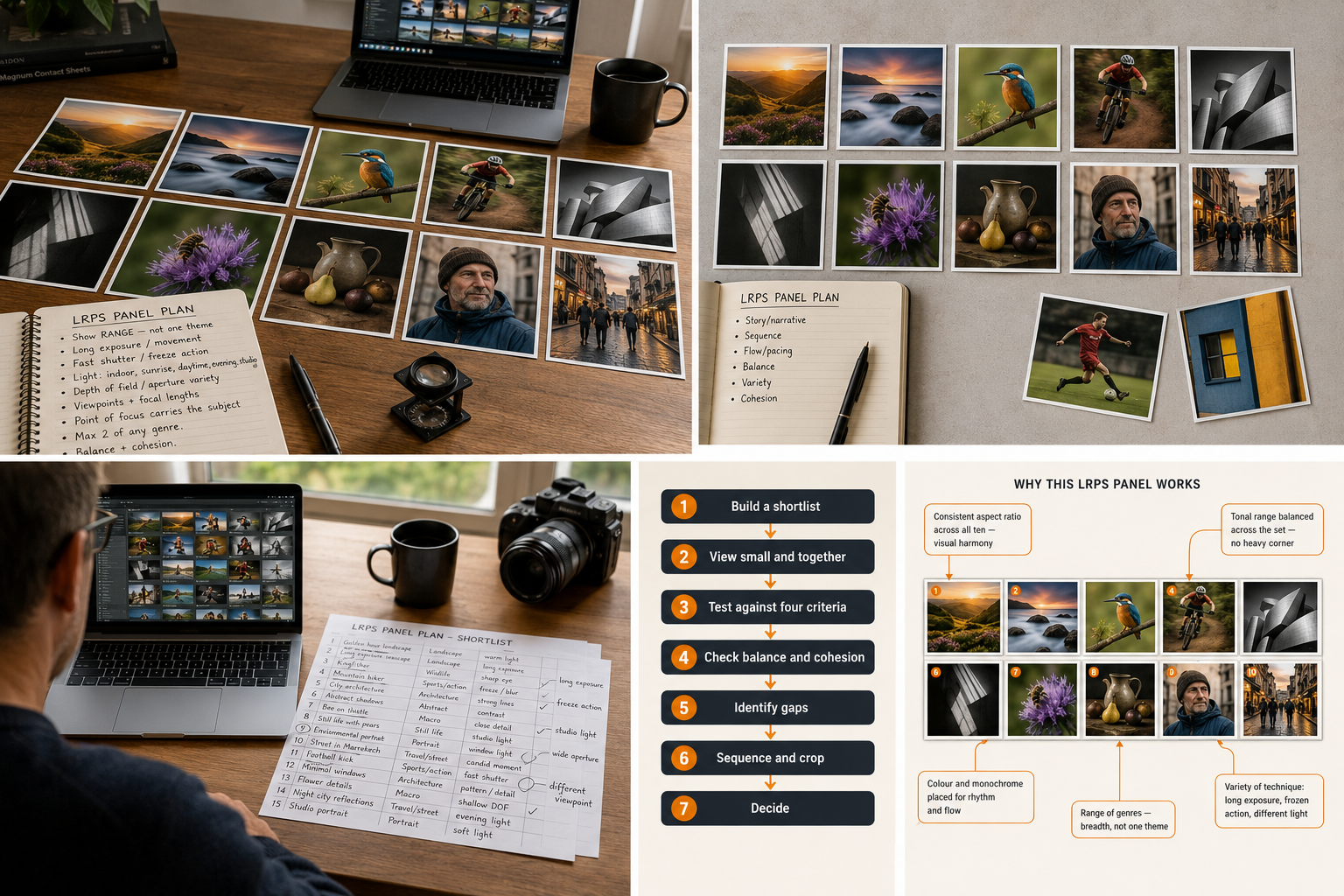
The Licentiate is the first of the Royal Photographic Society’s three Distinctions, and for many photographers it is the first time their work is formally assessed against a published standard. It is an achievable, welcoming level — but it is not a soft one. A Licentiate portfolio of ten images is assessed, scored and moderated against four specific criteria, and the photographers who pass first time are almost always the ones who planned the portfolio rather than simply gathered their ten best photographs.
This article is about that planning stage: understanding what the Licentiate actually asks for, deciding whether you are ready, choosing and shaping ten images that work together, and testing the portfolio honestly before you submit. If you are weighing up the Associate instead, or have already passed the Licentiate, the planning approach for that next level is covered in a companion guide on how to plan an ARPS panel. For now, the focus is the Licentiate — and the principle that the work begins at a desk, not in the field.
Is the Licentiate the right step for you?
The Royal Photographic Society offers three levels of Distinction — Licentiate, Associate and Fellowship. The Licentiate, introduced in 1972, is described by the Society as a benchmark of achievement and a testament to a photographer’s commitment to their own development. It is an open and approachable level, with no restriction on subject matter, designed for photographers developing their competence in camera work, visual awareness, technical quality and presentation.
It suits you if you have a reasonable command of your camera and editing, and can produce consistently good images across more than one subject. It does not require a single theme or a specialism — in fact, the opposite. The Licentiate rewards range: a portfolio that shows you can handle different subjects, conditions and techniques while still presenting a balanced, cohesive set of ten. If you are still finding consistency in your results, a few more months of structured practice before applying is time well spent. The Licentiate is not a race, and a portfolio submitted before it is ready simply collects a feedback letter.
One thing the Licentiate is not is a smaller version of the Associate. The Associate asks for a single genre, a personal voice and a Statement of Intent. The Licentiate asks for breadth and competence. Planning an LRPS panel means planning for variety held together by quality — a different task, and the subject of the rest of this guide.
What an LRPS panel actually asks for
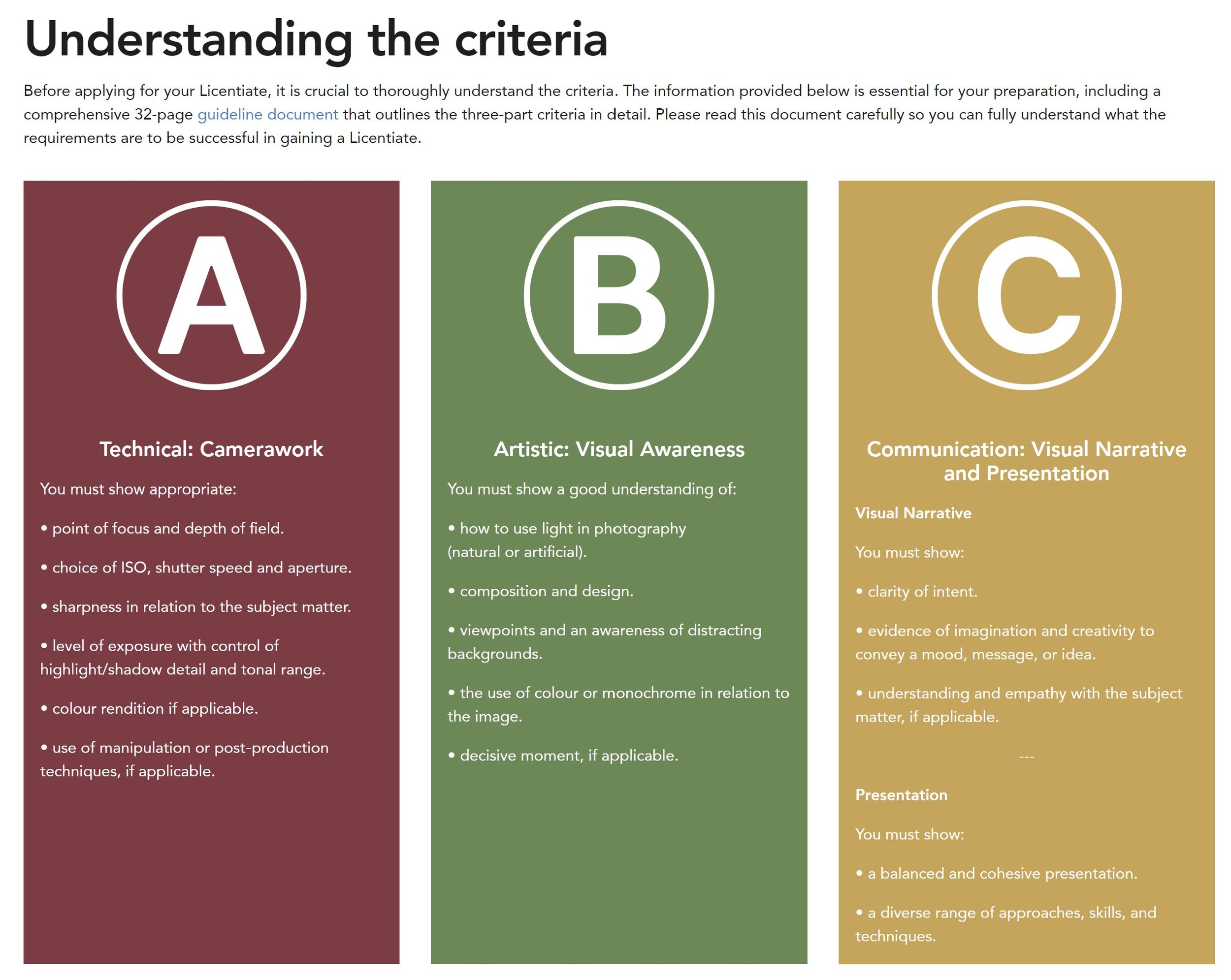
A Licentiate portfolio is ten digital images, ordered and presented in a way of your own choosing. Every one of the ten is assessed against the same four criteria — there is nowhere for a weak image to hide. The four criteria are:
Criterion A — Technical (Camerawork): effective focus and depth of field; appropriate choice of ISO, shutter speed and aperture; sharpness relative to the subject; well-controlled exposure with highlight, shadow and tonal detail; accurate colour rendition; and controlled, appropriate post-processing.
Criterion B — Artistic (Visual Awareness): understanding of light, composition and design, viewpoint and backgrounds, the use of colour or monochrome, and — where relevant — the decisive moment.
Criterion C(a) — Communication (Visual Narrative): clarity of intent, imagination and creativity in conveying a mood, message or idea, and empathy with the subject.
Criterion C(b) — Communication (Presentation): a balanced and cohesive portfolio that evidences a diverse range of artistic, technical and photographic techniques.
It is worth being precise about that fourth criterion, because it is the one most often underestimated. Although intent, narrative and presentation are grouped under Communication, Criterion C(a) and Criterion C(b) are scored separately. Presentation — how the ten images are selected, balanced and sequenced as a set — is assessed in its own right. This is exactly why a Licentiate submission is a planned panel and not a folder of strong singles: half of the “Communication” score is about the portfolio as a whole.
How the scoring actually works
Understanding how a Licentiate portfolio is scored changes how you plan it. The submission is assessed independently by three assessors. Each assessor awards up to six points against each of the four criteria, so each assessor can give a maximum of 24 points, and the maximum total is 72.
To be awarded the Licentiate, the portfolio must reach at least 12 points under each of the four criteria — and, crucially, each individual assessor must award at least 4 points against each criterion. A score of 3 or fewer from any assessor against any criterion means the application is unsuccessful, unless a moderation review applies. In the score descriptors, 4 points means the portfolio “adequately demonstrates all criteria”; 3 points means it only “minimally” does.
The planning lesson from this is simple but important: you cannot trade a brilliant image against a weak one. A panel with eight outstanding photographs and two that only minimally meet a criterion is at real risk, because that weakness is visible to every assessor across the whole set. Consistency across all ten images, against all four criteria, is what passes — not peaks.
Why the planning stage is the real work
Because every image is assessed against every criterion, and because consistency beats peaks, the Licentiate is won at the planning stage. Planning an LRPS panel is really three connected jobs: deciding whether each candidate image is genuinely strong enough on its own, deciding whether the ten work together as a balanced and cohesive set, and identifying what is missing so you can shoot it deliberately.
Doing this on paper — or on screen, with small thumbnails you can move around — is far cheaper than discovering the gaps late. A photographer who realises early that their ten candidates are all landscapes in similar light has time to add the variety the Presentation criterion expects. A photographer who discovers it after submitting simply receives feedback to that effect. Planning is also where honesty costs least: setting aside a favourite image that does not serve the panel is a minor disappointment now and a major one later.
Choosing ten images that work together
The Royal Photographic Society’s guidance is explicit about what a balanced and cohesive portfolio means, and it is worth planning against those words directly.
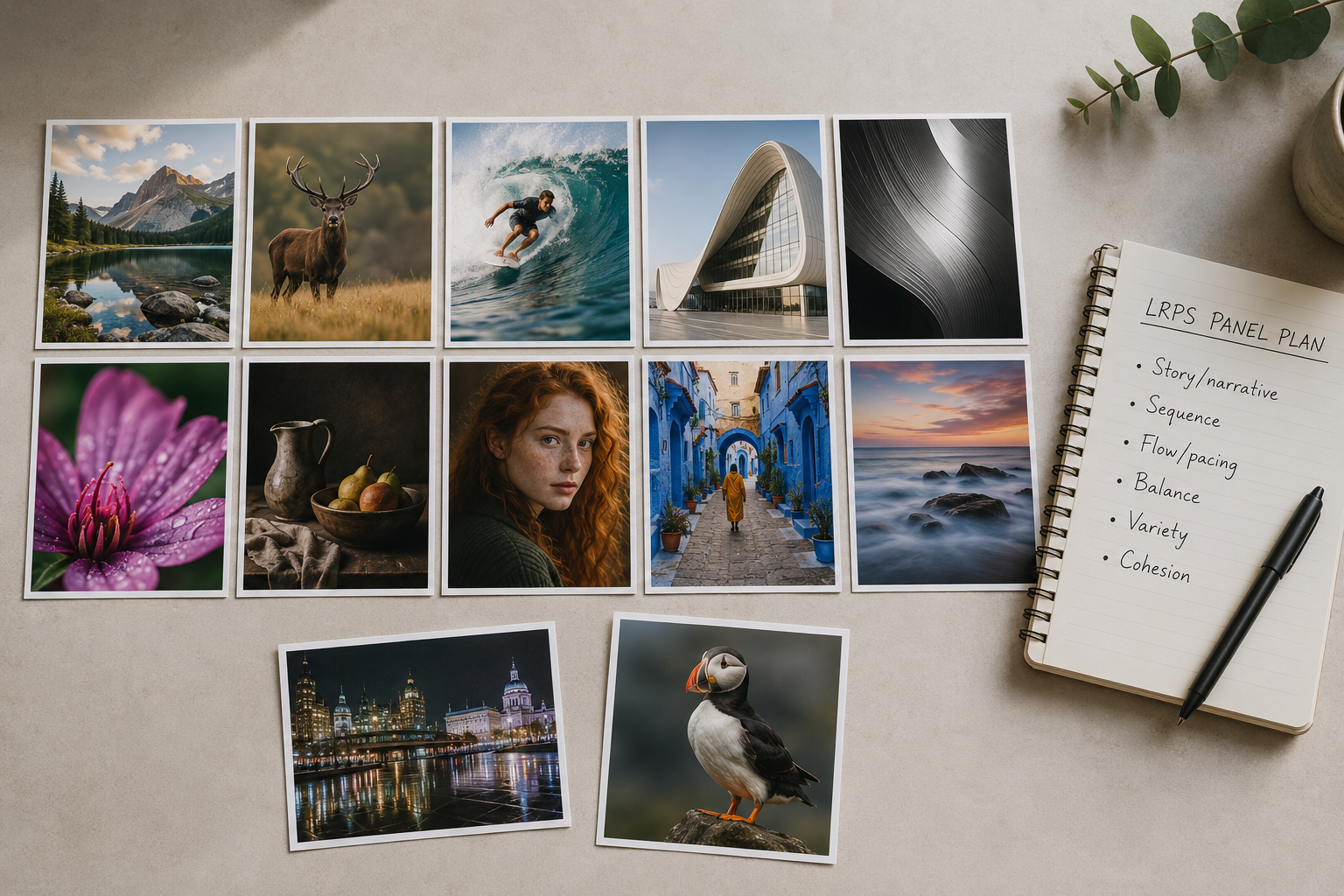
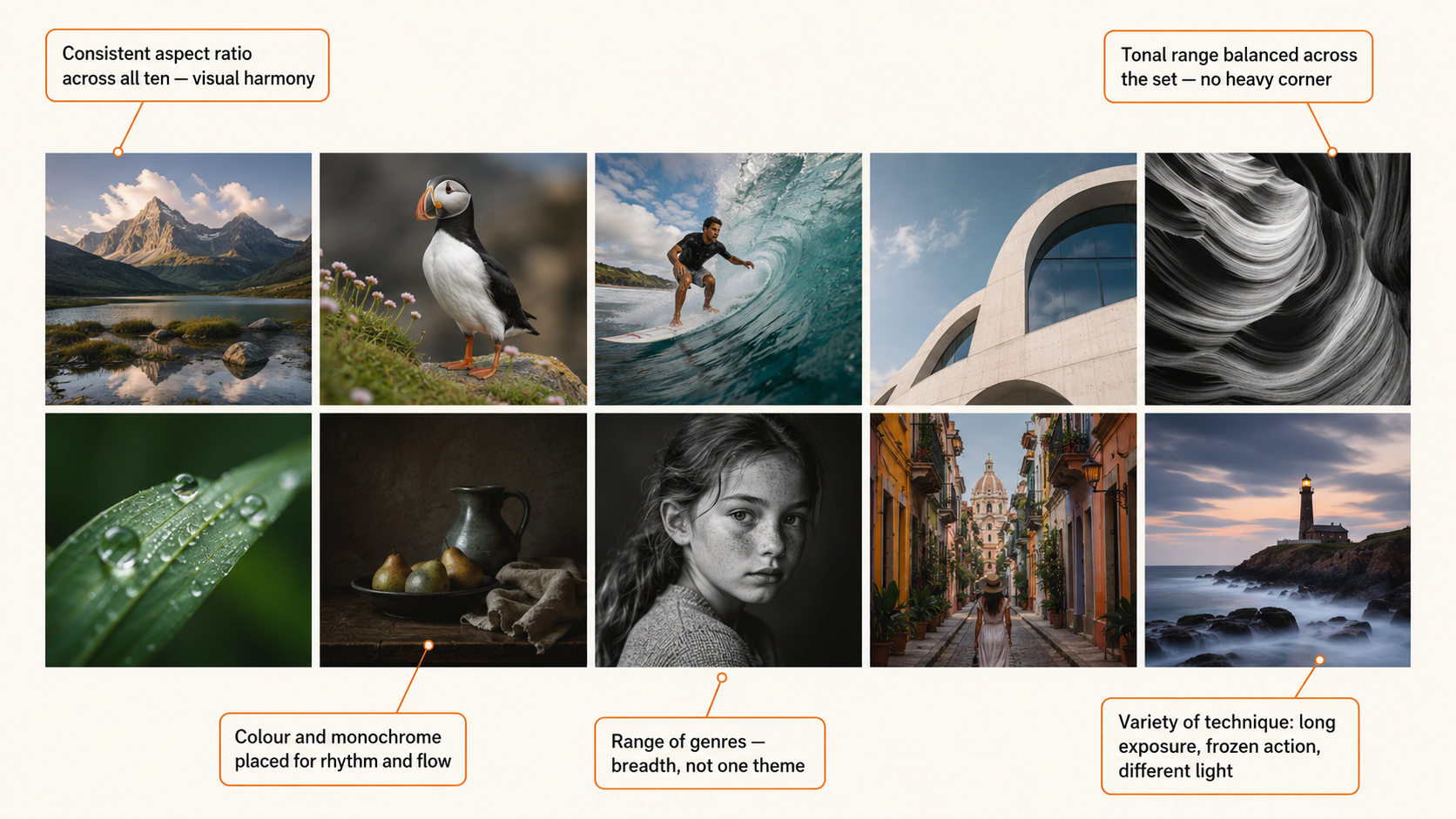
Balance means the ten images show proficiency and versatility across different kinds of photography — the guidance gives portraits, landscapes, abstract and still life as examples — and that they are distributed evenly in terms of colour, composition, lighting and visual impact. A panel weighted heavily toward one subject or one kind of light is not balanced, however good the individual frames.
Cohesion means the ten still feel like one body of work — a unified aesthetic tying the set together through consistent style, editing, colour palette or mood. Balance and cohesion pull gently against each other, and holding both at once is the central craft of an LRPS panel: enough variety to show range, enough consistency to feel deliberate.
The guidance also notes that aspect ratio is a creative choice, not a constraint. You are not bound to your sensor’s native ratio; considered cropping can strengthen an image and help the panel sit together. At the same time, the aspect ratios across the panel should be chosen to maintain visual harmony when the ten are seen as a set. Images may share subject matter, but to avoid repetition they must show a variety of approach.
Building a shortlist and a shot list
With the criteria clear, planning becomes practical. Two lists are worth building before you commit to a final panel.
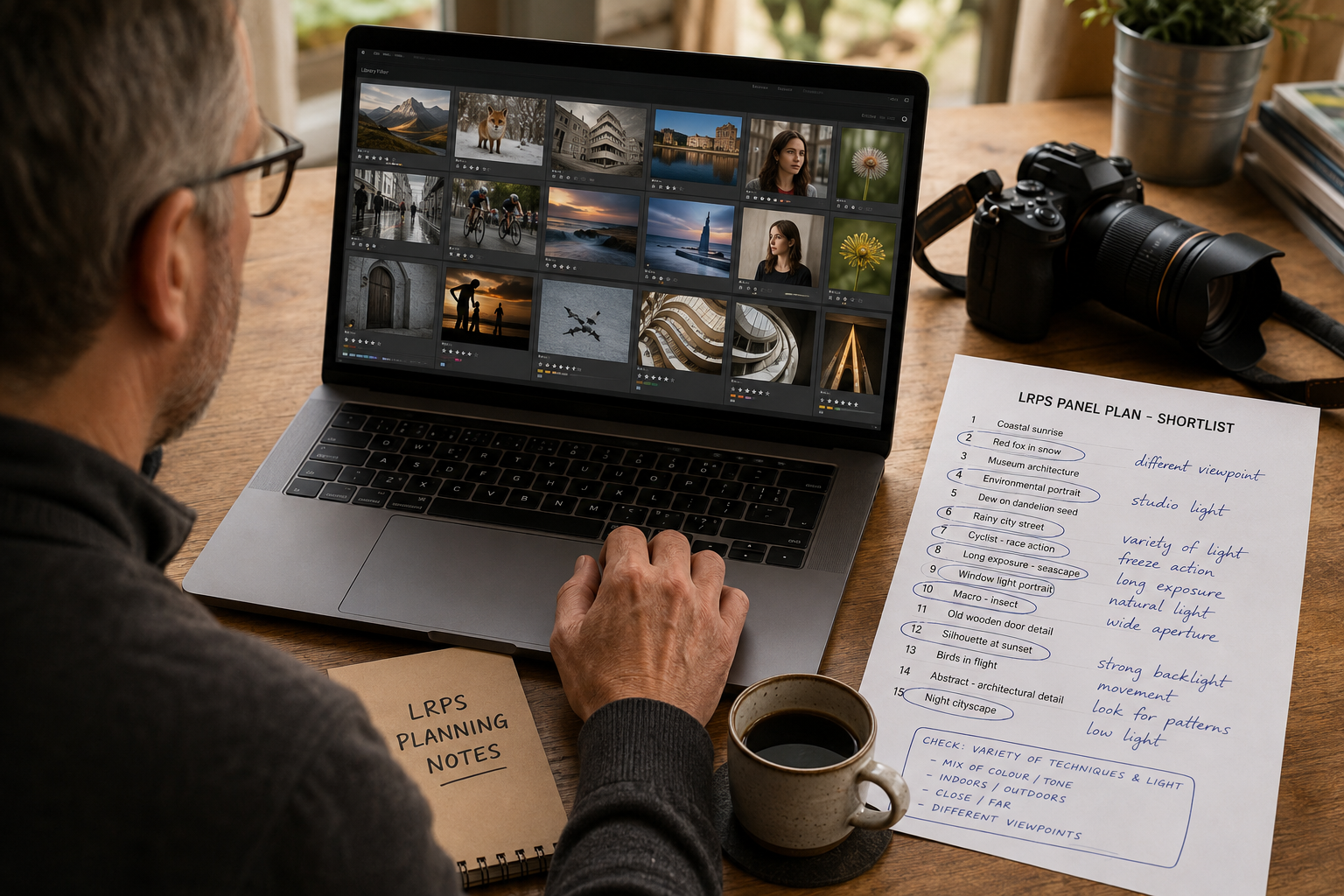
First, a shortlist of existing candidates. Gather every image you believe could meet all four criteria — aim for more than ten, perhaps fifteen to twenty, so you have room to choose. View them small and together, not one at a time at full size; the Presentation criterion is about the set, and small thumbnails reveal balance and repetition that full-screen viewing hides.
Second, a shot list for the gaps. Once you can see your shortlist as a group, the gaps become obvious — perhaps every image is in soft light, perhaps there is no portrait, perhaps three frames are too similar. List the specific new images that would fill those gaps, and treat them as deliberate, planned shoots rather than hoping the right frame turns up. A Licentiate panel almost always benefits from a few images made specifically to balance the set.
Testing whether your portfolio is ready
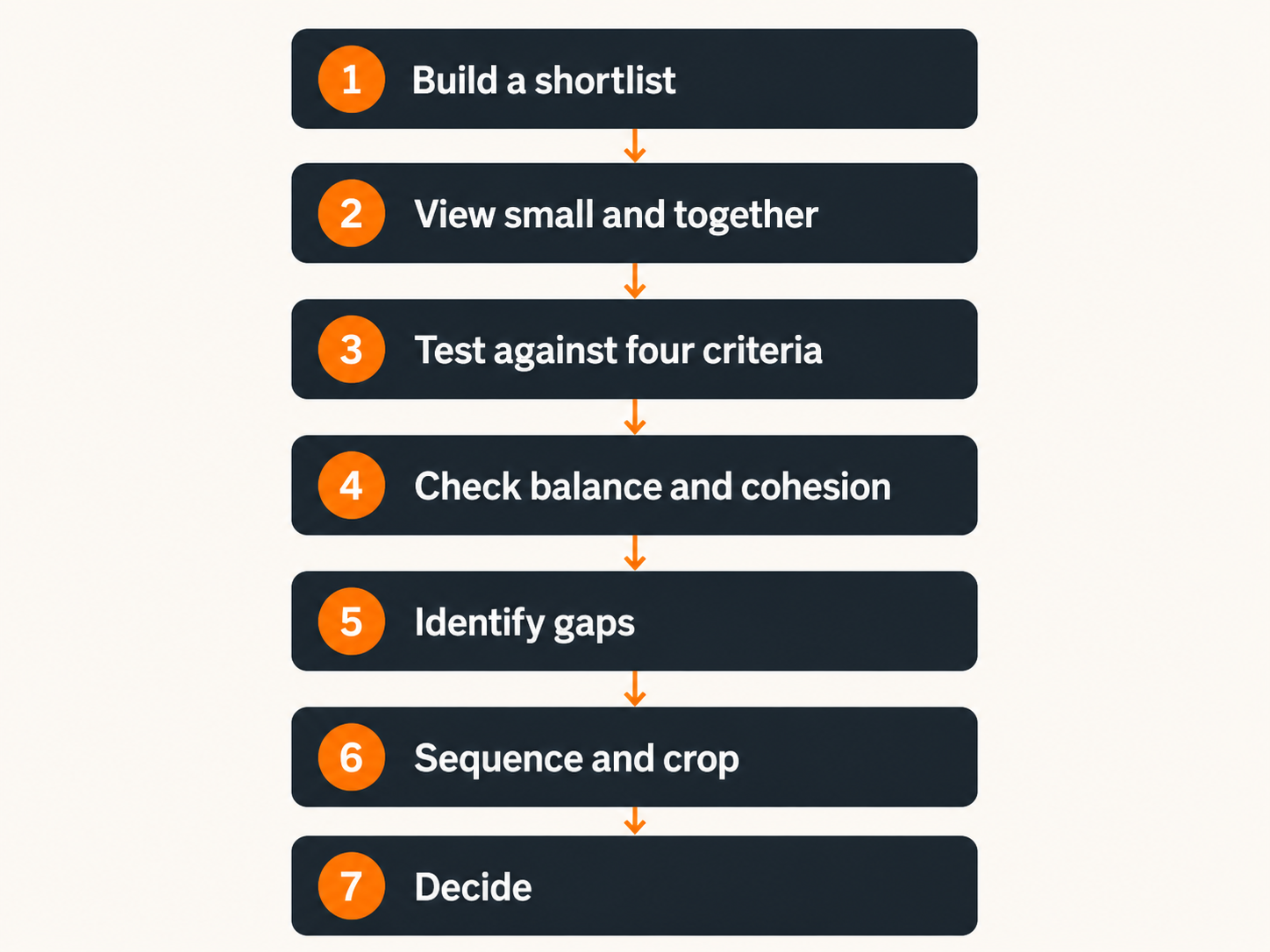
Planning should end with a deliberate readiness test. Work through it in order; the aim is an honest decision — submit, refine or keep shooting — before you book an assessment.
Common mistakes at the planning stage
Most unsuccessful Licentiate submissions fall down for reasons that were visible, and fixable, at the planning stage.
Submitting ten favourites instead of a planned panel. Strong individual images that were never chosen to work together rarely satisfy the Presentation criterion. The panel needs balance and cohesion by design.
Too little variety. Ten images of one subject, or all in similar light, struggle against the requirement to evidence a diverse range of techniques. Range is a Licentiate virtue — plan for it.
Letting two weak images ride along. Because every assessor scores every criterion, a couple of images that only minimally meet a criterion put the whole submission at risk. There is no averaging-out of a weak frame.
Over-processing. The guidance specifically names over-sharpening and excessive noise reduction as very common mistakes. Heavy-handed editing is more likely to cost technical marks than earn them.
Viewing images only at full size. Balance, repetition and tonal weighting across the set are far easier to judge from small thumbnails seen together. Plan the panel as a group, not as ten separate pictures.
Using generative AI. The Royal Photographic Society does not permit any image, or any element of an image, made using a generative AI feature in a Distinctions submission. A proven breach disqualifies the entire submission. Keep your portfolio — and your editing — genuinely photographic.
How the Licentiate compares with the Associate
If you are likely to continue towards the Associate, it helps to see how the two levels differ — because the skills you build planning a Licentiate panel are, in the Society’s own words, an essential prerequisite for success at Associate and Fellowship.
Where to read the official requirements
This article is a planning guide; it does not replace the Royal Photographic Society’s own published criteria and guidance, which are the authority and are revised periodically. Before you commit to a plan or book an assessment, read the current official documents in full.
Key Takeaways
The Licentiate rewards breadth and competence, not a single theme: plan for variety held together by quality.
Ten images are assessed against four criteria — Technical, Artistic, Visual Narrative and Presentation — and every image is judged against every criterion.
Scoring is unforgiving of weak images: each assessor must award at least 4 of 6 points per criterion, so consistency beats peaks.
Presentation is scored in its own right — balance and cohesion across the set are half of the Communication score.
Build a shortlist larger than ten, view it small and together, and plan deliberate shoots to fill the gaps.
End planning with an honest decision: submit, refine, or keep shooting.
Conclusion and Summary
A Licentiate panel is not ten good photographs in an envelope. It is a planned, balanced and cohesive portfolio in which every image earns its place against four criteria and three assessors. The photographers who pass first time are the ones who treated planning as the real work — understanding the criteria, choosing images that genuinely work together, shooting deliberately to fill the gaps, and testing the set honestly before booking an assessment.
If you have built a shortlist and worked through the readiness test above, you are most of the way there. If you would value an experienced second opinion on portfolio selection, balance and sequencing — the parts hardest to judge alone — that is what my RPS distinctions mentoring is built around. Most clients begin with a block of six one-hour Zoom sessions taken across six to twelve months, with more added if needed; the mentoring is independent and not officially accredited by the Royal Photographic Society, and the advice is based on my own experience holding both the Licentiate and Associate distinctions and mentoring others through the process. The Society’s own Advisory Days and One2One reviews are excellent and well worth attending alongside. Whichever support you choose, plan the panel first — the submission that follows will be far stronger for it.