Building a Successful RPS Panel: An ARPS Case Study

Building a Successful RPS Panel: An ARPS Case Study

Table of Contents Show
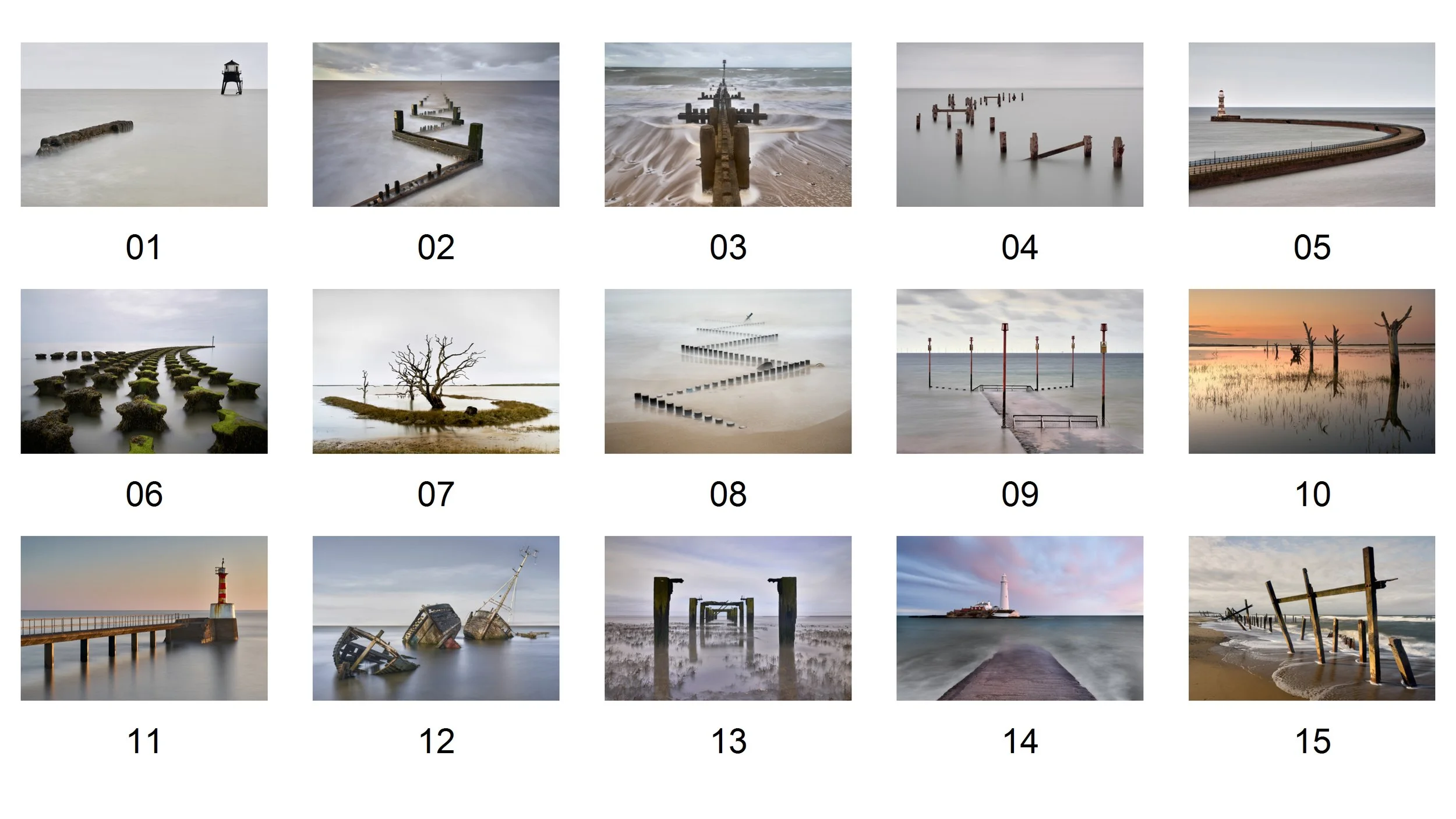
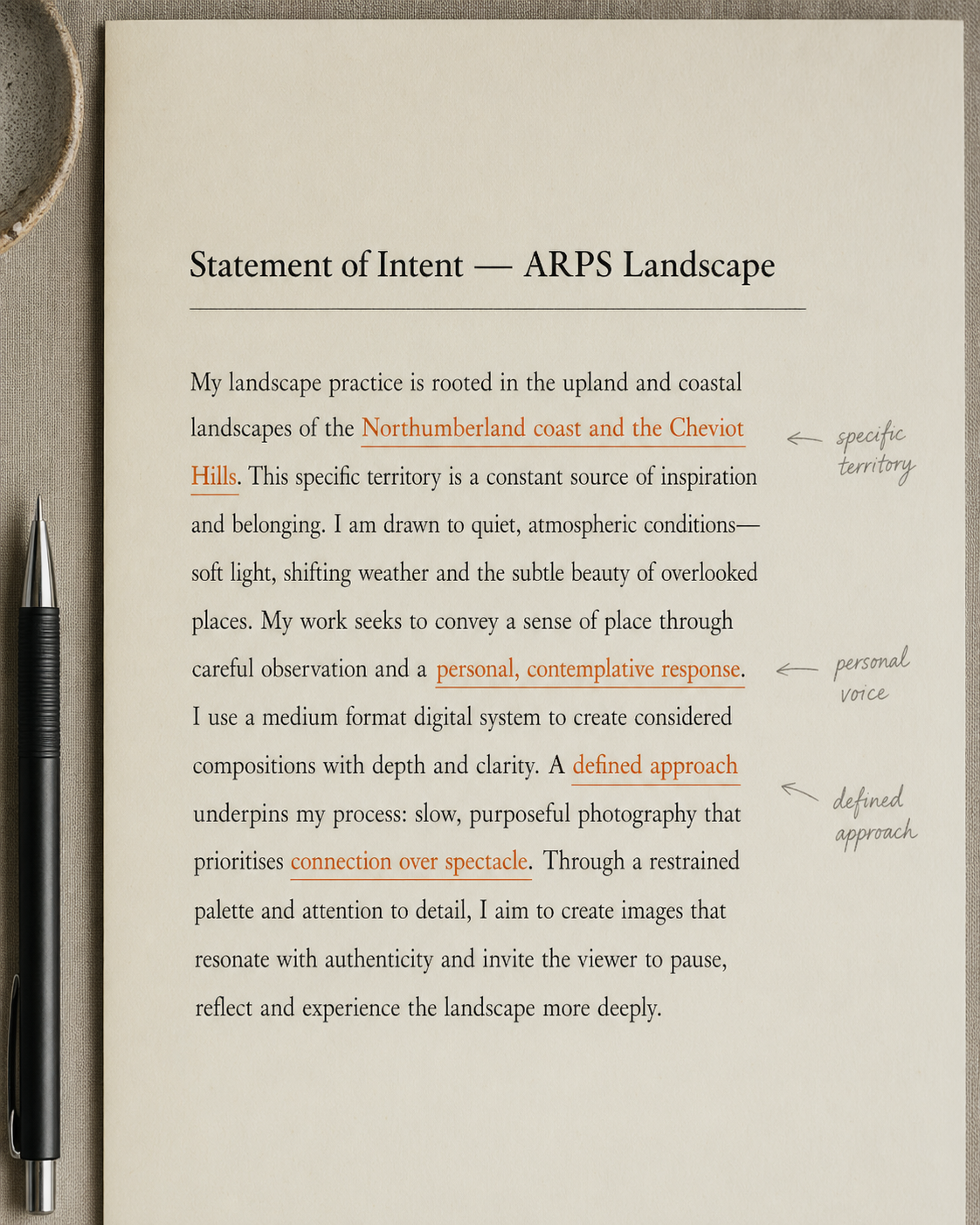
    This series of images are presented, with a fine art perspective, depicting coastal subjects, piers and boats, both on the coast and in estuaries. The photographic typology is of functional structures on the pathway towards dereliction and abandonment.

    The intent originated from noticing the effort of mankind to create and to maintain these structures, together with the destructive power of nature.

    The groynes continue to be overtaken by nature and are no longer effective in reducing coastal erosion. The piers have been created by mankind to use the sea, in a bygone era, and are now no longer functional. The coastal flood defences have been breached, resulting in inland flooding and the death of trees. This process has been occurring for several hundred years, is present now and ongoing, in the sea, estuaries and rivers.

    All have become overwhelmed, becoming abandoned and derelict, and are now a hazard to mankind.

    The single most useful thing a photographer working toward an RPS distinction can see is not a successful panel — it's the same photographer's failed panel and successful panel side-by-side, with the decisions behind each made visible. The technical layer of panel building is well documented in the RPS guidance booklets. The harder, less-documented layer is the judgement that turns a strong individual portfolio into a panel that hangs together as a coherent body of work — and the editorial discipline to remove images you love because they don't serve the panel as a whole.

    This article is an Applied Learning case study built around exactly that comparison. Peter Orton failed his first RPS Associate (ARPS) Landscape submission. After working through a structured mentoring programme with me, he resubmitted with a substantially revised panel and passed. Both panels are presented below as videos with my voice-over commentary on what each panel was trying to do, why the first one didn't work, and what changed in the second one. For Peter's own account of the process and his reflections on the journey, see the Peter Orton case study interview.

    Why panel building is its own discipline

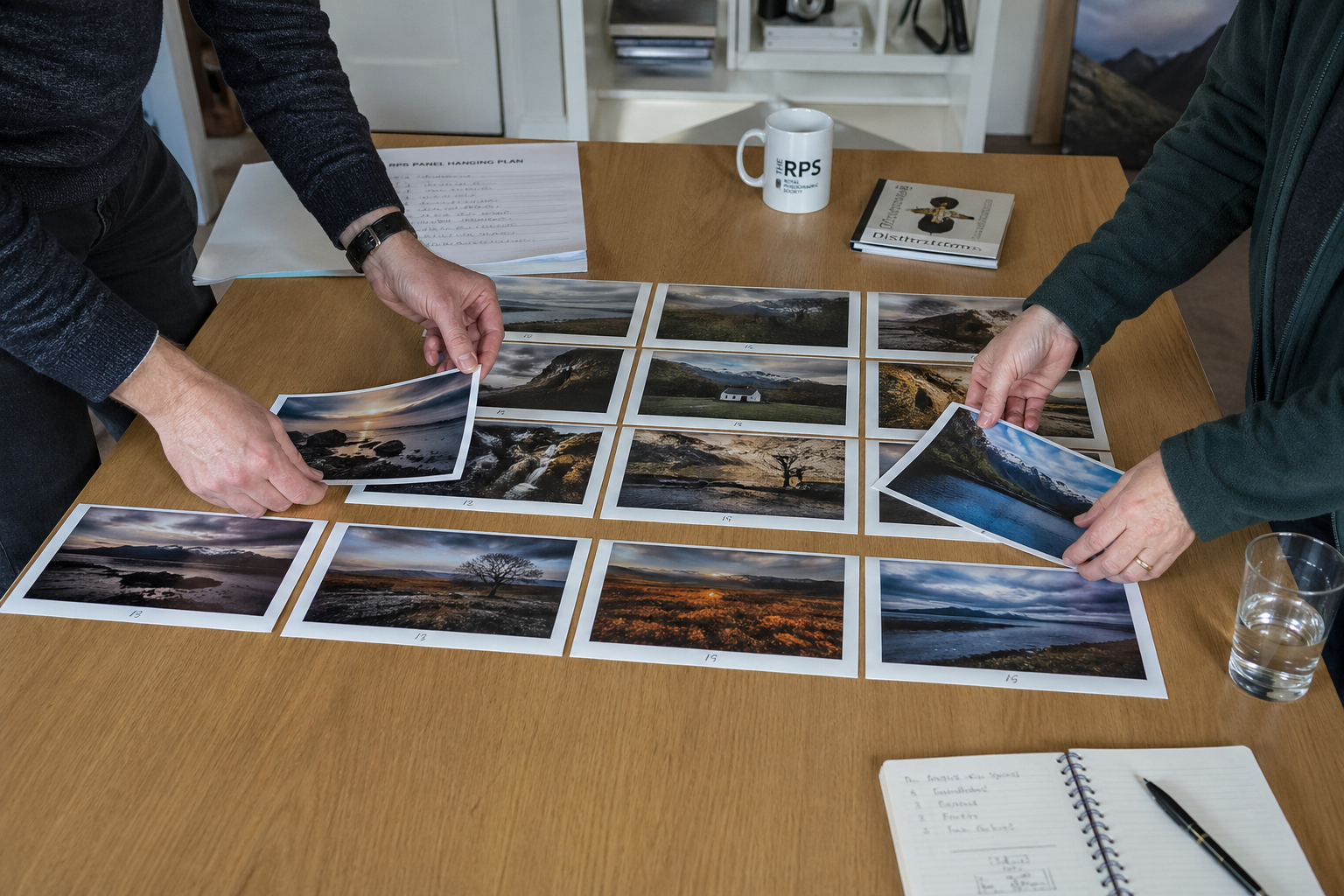
    Most photographers approaching an RPS distinction for the first time make the same assumption: if my individual images are strong enough, the panel will follow. It rarely does. Strong individual images are necessary but nowhere near sufficient. A panel is a collective object — fifteen images for ARPS, ten for LRPS, presented together — and assessors evaluate it as such. The hanging plan itself is sometimes called the eleventh image (LRPS) or the sixteenth (ARPS), because how the panel reads as a whole matters as much as how individual frames perform.

    Three things make panel building distinct from individual image-making:

    • Sequencing matters. The order images appear in the hanging plan, edge-images that face inward toward the centre, balance between portrait and landscape orientations, the visual rhythm across the row — all of this is panel-level work that doesn't exist when you're presenting individual frames.

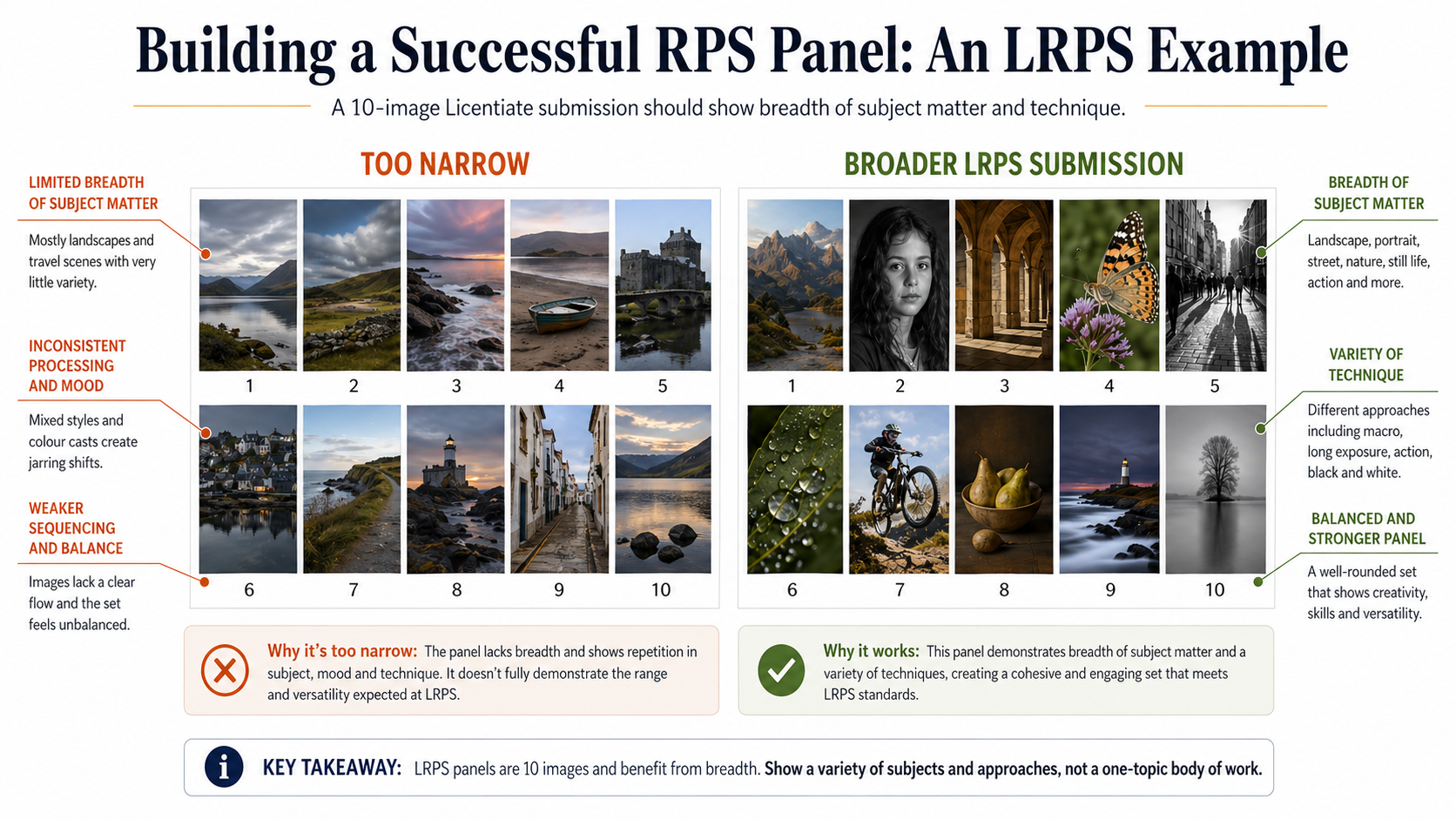
    • Breadth without disjointedness. LRPS specifically requires variety of approach and technique while remaining cohesive. ARPS at single-genre level (Landscape, Travel, Natural History, etc.) requires a recognisable body of work with a clear voice. Both demand a delicate balance between range and unity that's the panel's central editorial challenge.

    • Editorial ruthlessness. The most common reason mentoring clients tell me they fell short on a first attempt is the same: they couldn't bring themselves to drop a beloved image that didn't serve the panel. Panel building requires the discipline to put aside images you love because the panel is stronger without them. That editorial decision is uncomfortable, and it's why mentoring helps — the third party can be ruthless in a way the photographer often can't be alone.

    Across more than twenty Licentiate distinctions and four Associate distinctions I've mentored, the technical floor is rarely the issue. The judgement floor — sequencing, balance, breadth-versus-depth, ruthless exclusion — is where panels succeed or fail. The case study below makes that visible.
    Building a Successful RPS Panel

    What an RPS panel actually requires

    Before showing the case study, a brief refresher on what each distinction actually demands. Panel format and assessment criteria differ between Licentiate and Associate level, and understanding the difference is itself part of the work — especially when stepping up from L to A.

    RPS distinction panel format at a glance — the practical specification for each level. The categorical shift in what's being assessed (variety vs body of work) is more important than the difference in image count.

    Element Licentiate (LRPS) Associate (ARPS)
    Number of images 10 15
    Hanging plan Yes — the eleventh image; how the panel reads as a whole Yes — the sixteenth image; assessors evaluate the panel as a hanging object
    Statement of Intent Optional but recommended Required — frames every image and assessment
    Subject focus Variety of approach (subject can vary, but cohesion required) Single defined genre (Landscape, Travel, Natural History, etc.)
    What's assessed Solid technical skills, creative eye, variety of approach Cohesive body of work, personal voice, complete technical command
    Editorial discipline Breadth without disjointedness Depth and recognisable voice within a defined territory
    Common reason for failure Technical inconsistency, weak sequencing, including too many similar images Style range too wide, voice not yet recognisable, panel reads as portfolio

    Source: RPS Distinctions guidelines (refer to the official RPS Distinctions handbook on the Society's website for the most current criteria).

    The progression from L to A is not merely "more images of similar quality" — it's a categorical shift in what's being assessed. Where Licentiate looks for variety of approach within an emerging photographer's range, Associate looks for a coherent body of work in a defined genre with personal voice and technical command. Panels that fail at A level often do so because the candidate has prepared an A panel using L-level thinking — a strong portfolio rather than a focused body of work.

    Submission 1: Peter's original ARPS landscape panel

    Peter's first ARPS Landscape submission was assembled from his strongest individual landscape photographs over several years of work. The images were technically competent. Some were genuinely strong individual frames. But the panel as a whole did not receive ARPS — and the assessors' feedback, when it arrived, identified specific reasons for the outcome. The video below presents the original panel image-by-image with my commentary on what each image was contributing, where the panel hung together, and where it didn't.

    What was missing

    Looking at the first panel as a whole, three patterns emerged that explained the outcome:

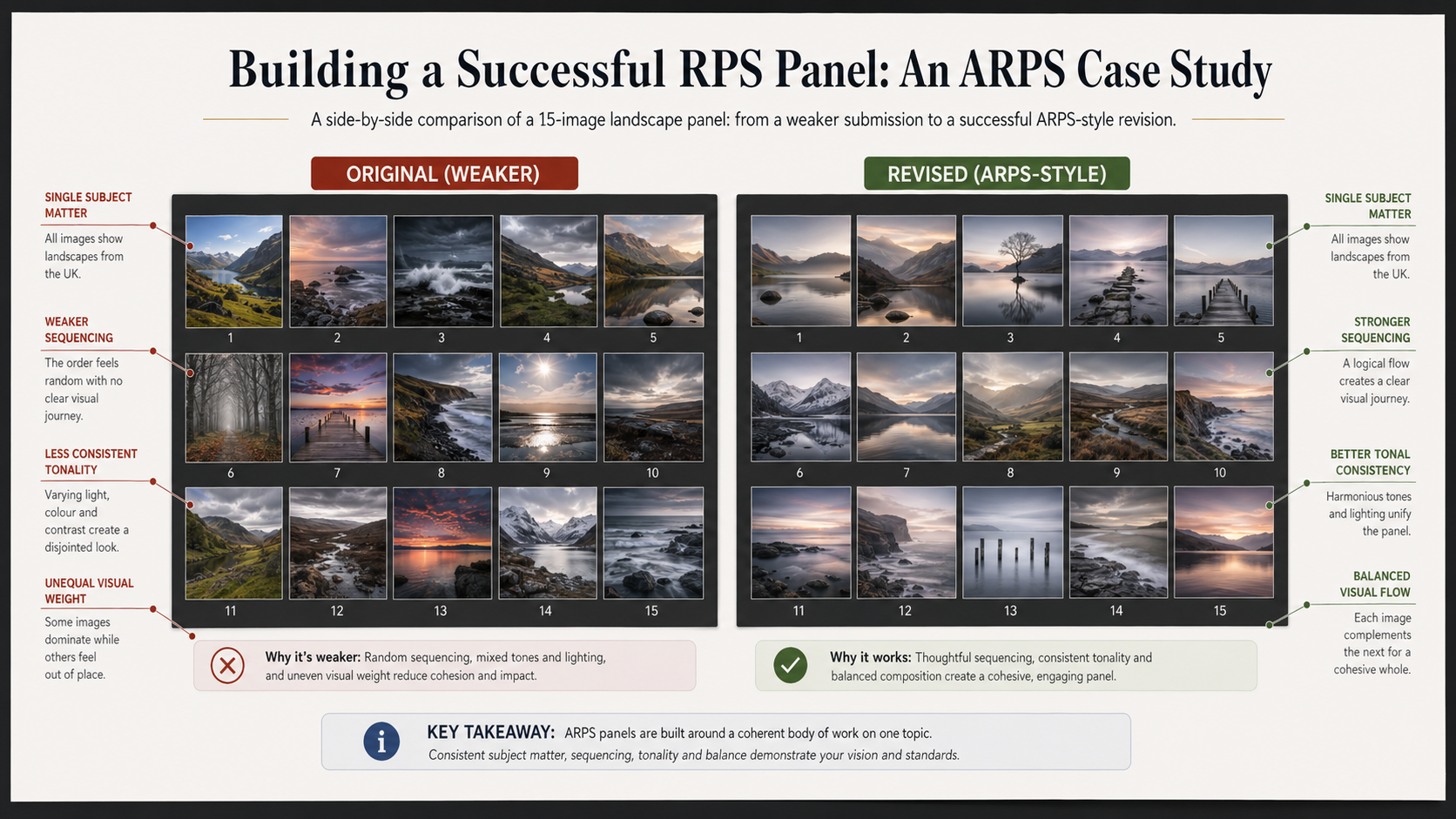
    • Style range too wide for ARPS. The panel mixed long-exposure seascapes, intimate woodland scenes, and dramatic mountain landscapes — all strong in their own right, but they read as a portfolio of capable work rather than a body of work with one voice. ARPS Landscape needs a recognisable photographer behind every frame; this panel had a recognisable competence but an ambiguous voice.

    • Sequencing issues. Edge images didn't face inward. Visual weight wasn't balanced across the hanging plan. Two strong images of similar subjects sat next to each other when they should have been separated. The panel as a hanging object didn't help itself.

    • Tonal and processing inconsistency. Some images carried a punchy, contrasty digital style; others sat in a softer, more restrained register. Across fifteen frames the differences in colour treatment and tonal balance read as unintentional inconsistency rather than deliberate range.

    None of these issues was visible to Peter when he was assembling the panel. They became visible only when we sat down to review the panel together as an editorial whole. This is the central value of mentoring — a competent photographer with strong individual images can be too close to the work to see what the panel is doing collectively.

    The mentoring process: the framework we used to rebuild

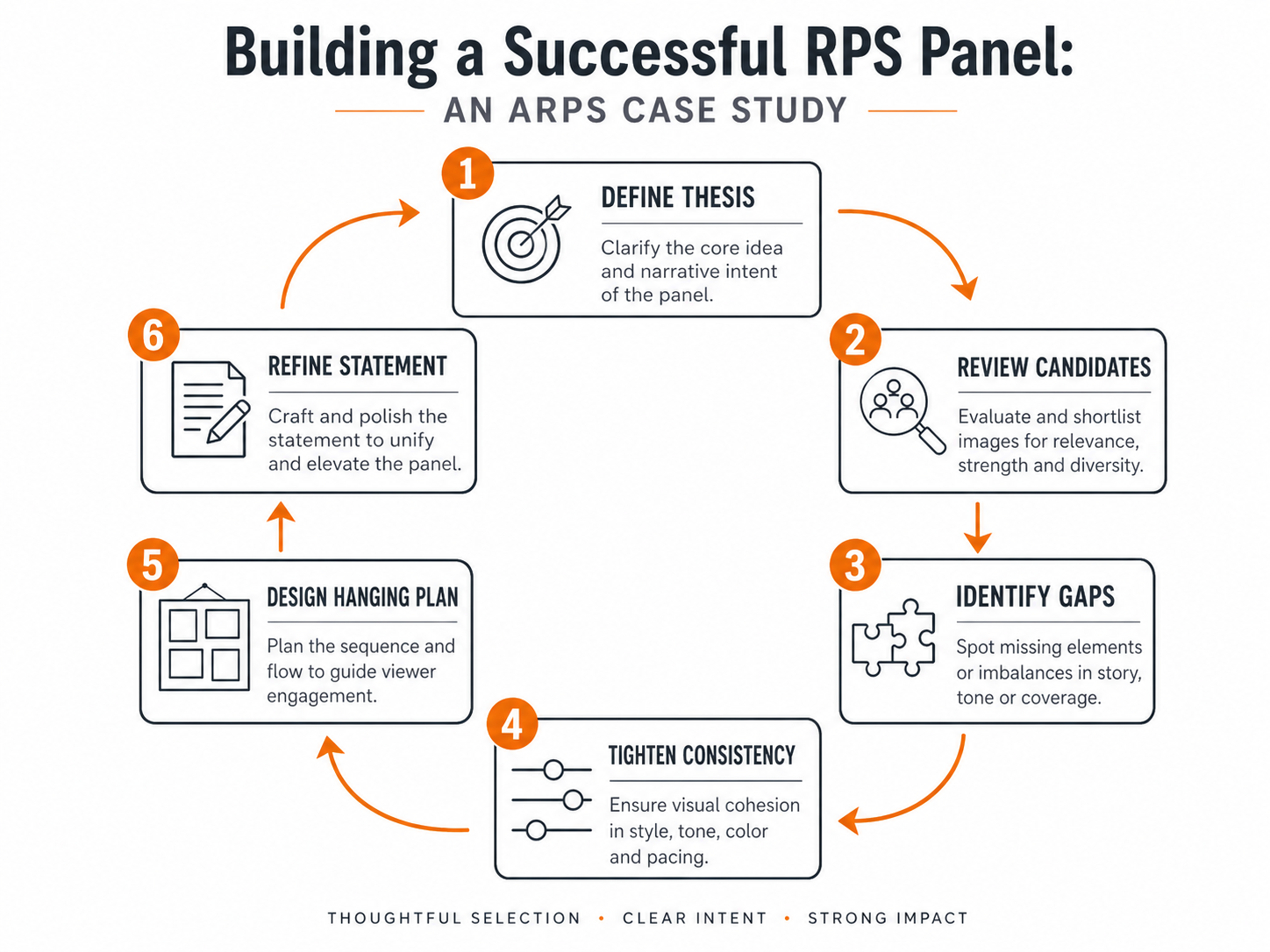
    The rebuild took several months and a series of structured Zoom mentoring sessions. The framework below is the same framework I use with every RPS mentoring client, applied to Peter's specific situation. It's a six-step decision rhythm that works for both LRPS and ARPS panels regardless of genre.
    Building a Successful RPS Panel

    The RPS panel-building decision framework

    A six-step decision rhythm I use with every RPS mentoring client, applicable to both LRPS and ARPS panels regardless of genre. The framework Peter and I worked through across his ARPS rebuild.

    1Define what the panel is about+
    Before reviewing any images, articulate what the panel is trying to say in one or two sentences. Not "my best landscape work" — that's a portfolio. A panel needs a thesis: a focused territory, a recognisable voice, a coherent body of work. For LRPS this is variety of approach within an emerging photographer's range; for ARPS this is depth and command within a defined genre. The Statement of Intent is built from this thesis. Most rebuild work begins by realising the original panel didn't have one — it had a collection of images instead.
    2Review every candidate image against the thesis+
    Once the thesis is clear, every candidate image gets two questions: does this serve the panel's voice, and is the image technically up to RPS standard. An image can be strong as an individual frame and still not serve the panel if it pulls the voice in a different direction. This is the editorial step where ruthlessness matters — and where mentoring helps because the third party can be unsentimental about images you love. In Peter's rebuild we started with around forty candidate images and ended with a longlist of about twenty-five that genuinely served the revised thesis.
    3Identify gaps and make new images if needed+
    From the longlist, what's missing? Are the seasons/light conditions/sub-genres balanced? Are there compositional types repeating that need replacing? Is there a tonal hole the panel needs filling? This is where targeted new shoots happen — sometimes one or two strategically planned outings can produce three or four new images that complete the panel. In Peter's case we identified three specific gaps and planned shoots around them. Two of the new images made the final cut.
    4Tighten technical and tonal consistency+
    Re-edit every shortlisted image so the panel reads as one body of work. Match colour temperature and tonal balance across all frames. Eliminate any technical issues — blown highlights, crushed shadows, distracting edges, unsharp focus, over-sharpening, ham-fisted retouching. Assessors at LRPS level have little tolerance for technical inconsistency; at ARPS level it kills a panel before voice and structure can be assessed. This stage usually takes longer than the photographer expects — Lightroom panels and synchronisation are essential tools.
    5Design the hanging plan as creative work+
    The hanging plan is the eleventh image (LRPS) or sixteenth (ARPS) — assessors evaluate the panel as a whole hanging object. Place the strongest single image as the anchor; balance edge images so they "look" inward toward the centre; alternate visual weight across the row; consider portrait/landscape orientation rhythm; check tonal flow left-to-right. Print thumbnails and physically rearrange them on a table. Try multiple sequences. The first arrangement is rarely the best. In Peter's panel, three different hanging plans were tried before the final one settled.
    6Refine the Statement of Intent and submit+
    The Statement of Intent is the last thing rewritten, not the first. Once the panel is finalised, write the Statement to match the panel that exists rather than the panel you originally imagined. Be specific: what subjects, what approach, what voice. Avoid generic photography language. Read the Statement aloud — if it sounds like it could describe any landscape photographer's work, it's not specific enough. Peter's Statement was rewritten three times across the mentoring period; the final version was unmistakably his rather than generic. Then submit, with sufficient time before the deadline for any final adjustments.

    Submission 2: Peter's revised panel — ARPS pass

    The revised panel kept four of the original fifteen images. The other eleven were either replaced from his existing portfolio (where stronger candidates existed but had been overlooked) or made specifically during the mentoring period to fill gaps. The Statement of Intent was rewritten to clarify the panel's voice. The hanging plan was redesigned around the strongest single image as the anchor and balanced inward from the edges. The video below presents the successful panel with my commentary on what changed and why each decision was made.

    What changed: a side-by-side

    The table below summarises the editorial decisions between the two panels. Most decisions feel obvious in retrospect; almost none of them were obvious to Peter at the start of the mentoring process.

    What changed between Peter's two ARPS panels — the editorial decisions that turned a failed submission into an ARPS pass. The theme itself was already strong; the issues were technical execution, panel cohesion, and editorial discipline within that theme.

    Element Original panel (failed) Revised panel (ARPS pass)
    Theme & Statement of Intent Strong theme already in place: coastal and estuarine structures (groynes, piers, flood defences) and the human effort to maintain coastlines against nature's destructive power Same theme retained — the body-of-work concept was strong from the start; the work was alignment of every image to it
    Image retention All 15 from the photographer's original submission 8 dropped, 7 retained as core baseline; 8 new images shot specifically to fill panel gaps
    Reasons images were dropped Sharpness issues; camera movement on long exposures; halos around rocks from post-production; soft details on posts; repetition with other posts/groyne shots; framing unbalanced; horizon at 50/50; posts intersecting horizon line; technique-led rather than vision-led Each retained image individually checked against four criteria: composition, technical execution, panel fit, alignment to Statement of Intent
    New images shot N/A — original submission used existing portfolio 8 new images researched and shot specifically to align with the Statement of Intent, complete the tonal range, and balance the overall panel layout
    Post-production Issues including halos around rocks, over-processing, and post-production decisions that couldn't be recovered without significant rework Several retained images re-edited with subtle changes — different framing, refined post-production, unified treatment across the panel
    Editorial discipline Strong individual images selected; less rigorously tested for repetition, panel fit, and alignment to Statement of Intent Through "brutal image critique & honesty", every image stress-tested against composition, technical execution, panel fit, and alignment to Statement of Intent
    Outcome Failed ARPS Landscape Passed ARPS Landscape

    Source: case study material as presented by Alan Ranger to camera clubs, with Peter Orton's permission.

    The most important change wasn't any single image swap — it was the shift in thinking from "these are my best individual landscape photographs" to "these fifteen images together represent who I am as a landscape photographer." Once that shift had happened, the editorial decisions about what to keep, what to drop, and what to replace mostly made themselves.

    Lessons that apply to any RPS panel

    Peter's case is specific, but the lessons generalise. Across more than twenty Licentiate panels and four Associate panels I've mentored to a 100% pass rate, the same patterns appear consistently:

    • The first attempt without mentoring rarely passes at the first time of asking. This is true even for genuinely talented photographers with strong individual portfolios. Many of my LRPS clients came to me after a failed first submission — not because their photography wasn't good enough, but because their panel wasn't built for assessment. Patricia Pearl LRPS, who passed with my mentoring in March 2026 after a failed first attempt, described the difference as needing someone "to ruthlessly exclude photographs from my submission that did not come up to scratch (however much I liked them myself) and to point out technical defects that I had been too casual to address."

    • Breadth not depth at LRPS; depth not breadth at ARPS. The L panel needs ten images that demonstrate range of capability while remaining cohesive. The A panel needs fifteen images that demonstrate command within a defined territory. Switching mentally between these two modes is harder than it sounds — many ARPS candidates fail because they prepared with L-level thinking. (The reverse mistake — preparing an L panel with A-level focus — also exists, and produces a panel that's too narrow to read as variety of approach.)

    • The Statement of Intent matters more than candidates expect. Assessors read the Statement before viewing the panel. It frames how every image is then evaluated. A vague or generic Statement leaves the panel unsupported; a precise, specific Statement helps the panel land. Rewriting the Statement of Intent is sometimes the single most impactful change in a rebuild — Peter's was rewritten three times during the mentoring process.

    • Hanging plan is creative work, not administrative work. Edge images facing inward, balance of portrait and landscape orientations, visual weight distributed across the row, tonal rhythm across the panel — all of this is part of the panel's success or failure. Treating the hanging plan as an afterthought is a reliable way to undermine an otherwise strong panel.

    • Get external eyes early and often. RPS Advisory Days are useful but limited — assessors look at your panel for ten minutes alongside many others. Sustained mentoring across several months gives you the kind of editorial scrutiny over time that no single-day advisory can provide. The photographers I've mentored who improved fastest are the ones who showed up consistently across the whole timeline rather than only as the deadline approached.
    Building a Successful RPS Panel
    Building a Successful RPS Panel

    RPS panel-building FAQ

    RPS distinctions and panel building: frequently asked questions

    Practical answers to the questions photographers ask when considering an RPS Licentiate or Associate distinction.

    What's the difference between LRPS and ARPS?+
    LRPS (Licentiate) is the entry distinction — ten images demonstrating solid technical skills, creative eye, and variety of approach. The panel needs cohesion but the subjects can vary. ARPS (Associate) is the next level — fifteen images forming a coherent body of work in a defined genre (Landscape, Travel, Natural History, Fine Art, etc.) with personal voice and complete technical command. The categorical shift from L to A is more important than the difference in image count: L assesses range; A assesses depth. Many ARPS candidates fail because they prepared an A panel using L-level thinking — a strong portfolio rather than a focused body of work.
    Do I need RPS membership to apply for a distinction?+
    Yes. RPS distinctions are awarded only to current members of the Royal Photographic Society. You'll need to be a paid-up RPS member at the point of submission. Membership also gives you access to RPS regional Advisory Days, the Distinctions handbook, and the Society's other resources — all of which are useful preparation alongside any independent mentoring you undertake. Check the current RPS website for membership tiers and prices, which change periodically.
    How long does it take to prepare an RPS panel?+
    Three to twelve months for most candidates, depending on starting point. Photographers who already have a strong existing portfolio that broadly fits the panel's thesis can sometimes prepare in three to six months of focused mentoring work. Photographers who need to make new images to fill gaps, or who are stepping up from L to A and need to build a more focused body of work, typically need six to twelve months. My RPS mentoring service runs over a twelve-month timeline by default to accommodate either pace. Rushing the process is a common cause of failure — six months is rarely too long, and three months is rarely enough unless your portfolio is already very close to a panel.
    Should I attend an RPS Advisory Day?+
    Yes, but as one input among several rather than as your only preparation. Advisory Days give you ten to fifteen minutes of feedback from RPS assessors on your panel — useful for reading their priorities and catching specific issues, but limited in scope. The candidates I mentor who attend Advisory Days alongside our sessions tend to use the Day's feedback to validate or challenge what we've worked on. Treat the Advisory Day as a checkpoint, not a substitute for sustained editorial work. Patricia Pearl, who passed LRPS with my mentoring in March 2026, attended an RPS Advisory before her first (failed) attempt and described it as not very helpful on its own — the structured mentoring afterwards was what made the difference.
    What happens if my panel fails?+
    You receive written feedback from the assessors detailing why the panel did not pass and what would need to change for resubmission. This feedback is genuinely useful and forms the foundation of any rebuild. There's no limit to resubmissions — many successful candidates pass on a second or third attempt rather than the first. Peter's case study above is exactly this scenario: failed first ARPS submission, structured rebuild over a multi-month mentoring period, successful resubmission. Failure is not the end of the journey; without external editorial support it's often the start of it.
    Do I need to print my panel, or can I submit digitally?+
    Both options exist but are assessed differently. Printed panels are typically printed at A4 (larger sizes can make technical issues such as softness or noise more obvious; smaller invites extra scrutiny). Mounts should be consistent — mixing mount sizes tends to be frowned upon. Digital submissions are accepted for some routes but require a fully calibrated digital projector for assessment, which carries colour-rendering risk. Most successful panels I've mentored have been printed. Check the current RPS Distinctions handbook for the specific submission options for your chosen distinction route, as these have evolved over time.
    Is RPS mentoring with Alan Ranger officially RPS-accredited?+
    No. My mentoring is independent and not officially RPS-accredited or endorsed by the Society as an organisation. The advice I provide is private and based on my own experience holding both LRPS and ARPS distinctions and mentoring others through the process. The RPS does maintain a register of RPS-recognised mentors which I'm part of, but my paid mentoring service is structured separately from any official RPS programme. The 100% pass rate from over twenty Licentiate and four Associate clients reflects the structured editorial work, not any official endorsement. The RPS itself runs Advisory Days and other support — these are excellent and complementary rather than competing with independent mentoring.
    How much does RPS mentoring cost?+
    Most clients begin with a block of six one-hour Zoom mentoring sessions and add more as needed across a twelve-month timeline. Sessions are flexible — you can space them out as your panel develops. Group classes are also available for those who prefer learning alongside other distinction candidates, with sessions held in groups of up to three over Zoom. Current pricing is on the RPS mentoring service page, and a free no-obligation initial chat is offered to confirm whether mentoring suits your specific situation before any payment.

    RPS distinctions and panel building: frequently asked questions

    Practical answers to the questions photographers ask when considering an RPS Licentiate or Associate distinction.

    What's the difference between LRPS and ARPS?+
    LRPS (Licentiate) is the entry distinction — ten images demonstrating solid technical skills, creative eye, and variety of approach. The panel needs cohesion but the subjects can vary. ARPS (Associate) is the next level — fifteen images forming a coherent body of work in a defined genre (Landscape, Travel, Natural History, Fine Art, etc.) with personal voice and complete technical command. The categorical shift from L to A is more important than the difference in image count: L assesses range; A assesses depth. Many ARPS candidates fail because they prepared an A panel using L-level thinking — a strong portfolio rather than a focused body of work.
    Do I need RPS membership to apply for a distinction?+
    Yes. RPS distinctions are awarded only to current members of the Royal Photographic Society. You'll need to be a paid-up RPS member at the point of submission. Membership also gives you access to RPS regional Advisory Days, the Distinctions handbook, and the Society's other resources — all of which are useful preparation alongside any independent mentoring you undertake. Check the current RPS website for membership tiers and prices, which change periodically.
    How long does it take to prepare an RPS panel?+
    Three to twelve months for most candidates, depending on starting point. Photographers who already have a strong existing portfolio that broadly fits the panel's thesis can sometimes prepare in three to six months of focused mentoring work. Photographers who need to make new images to fill gaps, or who are stepping up from L to A and need to build a more focused body of work, typically need six to twelve months. My RPS mentoring service runs over a twelve-month timeline by default to accommodate either pace. Rushing the process is a common cause of failure — six months is rarely too long, and three months is rarely enough unless your portfolio is already very close to a panel.
    Should I attend an RPS Advisory Day?+
    Yes, but as one input among several rather than as your only preparation. Advisory Days give you ten to fifteen minutes of feedback from RPS assessors on your panel — useful for reading their priorities and catching specific issues, but limited in scope. The candidates I mentor who attend Advisory Days alongside our sessions tend to use the Day's feedback to validate or challenge what we've worked on. Treat the Advisory Day as a checkpoint, not a substitute for sustained editorial work. Patricia Pearl, who passed LRPS with my mentoring in March 2026, attended an RPS Advisory before her first (failed) attempt and described it as not very helpful on its own — the structured mentoring afterwards was what made the difference.
    What happens if my panel fails?+
    You receive written feedback from the assessors detailing why the panel did not pass and what would need to change for resubmission. This feedback is genuinely useful and forms the foundation of any rebuild. There's no limit to resubmissions — many successful candidates pass on a second or third attempt rather than the first. Peter's case study above is exactly this scenario: failed first ARPS submission, structured rebuild over a multi-month mentoring period, successful resubmission. Failure is not the end of the journey; without external editorial support it's often the start of it.
    Do I need to print my panel, or can I submit digitally?+
    Both options exist but are assessed differently. Printed panels are typically printed at A4 (larger sizes can make technical issues such as softness or noise more obvious; smaller invites extra scrutiny). Mounts should be consistent — mixing mount sizes tends to be frowned upon. Digital submissions are accepted for some routes but require a fully calibrated digital projector for assessment, which carries colour-rendering risk. Most successful panels I've mentored have been printed. Check the current RPS Distinctions handbook for the specific submission options for your chosen distinction route, as these have evolved over time.
    Is RPS mentoring with Alan Ranger officially RPS-accredited?+
    No. My mentoring is independent and not officially RPS-accredited or endorsed by the Society as an organisation. The advice I provide is private and based on my own experience holding both LRPS and ARPS distinctions and mentoring others through the process. The RPS does maintain a register of RPS-recognised mentors which I'm part of, but my paid mentoring service is structured separately from any official RPS programme. The 100% pass rate from over twenty Licentiate and four Associate clients reflects the structured editorial work, not any official endorsement. The RPS itself runs Advisory Days and other support — these are excellent and complementary rather than competing with independent mentoring.
    How much does RPS mentoring cost?+
    Most clients begin with a block of six one-hour Zoom mentoring sessions and add more as needed across a twelve-month timeline. Sessions are flexible — you can space them out as your panel develops. Group classes are also available for those who prefer learning alongside other distinction candidates, with sessions held in groups of up to three over Zoom. Current pricing is on the RPS mentoring service page, and a free no-obligation initial chat is offered to confirm whether mentoring suits your specific situation before any payment.

    Key takeaways

    • Strong individual images are necessary but nowhere near sufficient. A panel is a collective object; assessors evaluate it as such.

    • Sequencing, breadth-versus-depth and ruthless exclusion are the editorial disciplines that distinguish strong panels from strong portfolios.

    • LRPS asks for breadth; ARPS asks for depth. Switching mentally between these two modes is the single most common pitfall when stepping up.

    • The Statement of Intent frames every image. Rewriting it is often the single most impactful change in a panel rebuild.

    • Hanging plan is creative work. Edge images face inward, visual weight is balanced, tonal rhythm carries across the row.

    • The first attempt without mentoring rarely passes. Even strong photographers benefit from sustained editorial scrutiny over several months — not a single-day advisory.

    • Editorial ruthlessness is the hardest part. Mentoring helps because a third party can be ruthless about images you love in a way you usually can't be alone.

    Continue learning

    Conclusion and summary

    RPS distinctions reward editorial judgement at panel level more than individual image quality, and the gap between a strong portfolio and a successful panel is exactly the gap that mentoring closes. Peter's case study makes the work visible: two panels by the same photographer, the same body of work as raw material, but one fails ARPS Landscape and the other passes — and the difference is almost entirely editorial. Image selection, sequencing, hanging plan, tonal consistency, Statement of Intent. None of it is gear. None of it is technical skill. All of it is judgement applied at the panel level rather than the individual-image level.

    The framework to internalise: panel as collective object first, individual frames second. LRPS is breadth not depth; ARPS is depth not breadth. Statement of Intent frames everything that follows. Hanging plan is creative work. Editorial ruthlessness — being willing to drop images you love when the panel is stronger without them — is the hardest discipline and the most important. Across more than twenty Licentiates and four Associates I've mentored to a 100% pass rate, the technical floor is rarely the issue; the judgement floor almost always is.

    If you're working toward an RPS Licentiate or Associate distinction and want structured mentoring with someone who has both held the distinctions himself and mentored more than twenty-four successful candidates to date, my RPS distinctions mentoring service is built around exactly the framework this case study illustrates. Sessions are flexible — most clients begin with a block of six one-hour Zoom mentoring sessions and add more as needed across the twelve-month timeline. The mentoring covers image selection, sequencing, hanging plan, Statement of Intent, technical refinement, and the iterative review process that turns a strong portfolio into a successful panel. Note that this is independent mentoring and not officially RPS-accredited; my advice is private and based on my own experience holding both LRPS and ARPS distinctions and mentoring others through the process. For a no-obligation conversation about whether mentoring would help your specific situation, schedule a free chat or email info@alanranger.com.