
How to find your Photography Style: Identify and Develop it
Updated 27 Sep 2026
Lesson 35 · Judgement
Recognise the choices that shape your photography style
Your style is not a genre, preset or formula. It is the pattern of attention and judgement that becomes visible across a body of work: what repeatedly interests you, how you organise it, how you want it to feel and which photographs you choose to keep.
This lesson brings the Composition Framework to its conclusion. Intention, restraint and observation help you make photographs; judgement helps you recognise which decisions are truly yours and how to develop them without turning them into rules.
Notice recurring choices
Compare photographs made at different times and in different places. Look for repeated attention, viewpoint, spacing, timing, atmosphere and relationships.
Go to the four sources of evidence →Understand what matters
Name the purpose behind those choices. Technique and composition become useful when they express what you care about.
Separate style from genre and technique →Develop through practice
Use projects, selection, sequencing, experiments and feedback to test your direction while allowing it to evolve.
Build a working direction →Table of Contents Show
Academy Composition Framework · Lesson 35
Where this lesson fits
Review a collection of your photographs and look for the subjects, relationships, light, moods and compositional decisions that repeatedly matter to you. These patterns help reveal your developing visual voice.
SEE → FEEL → TECHNIQUE → REVIEW
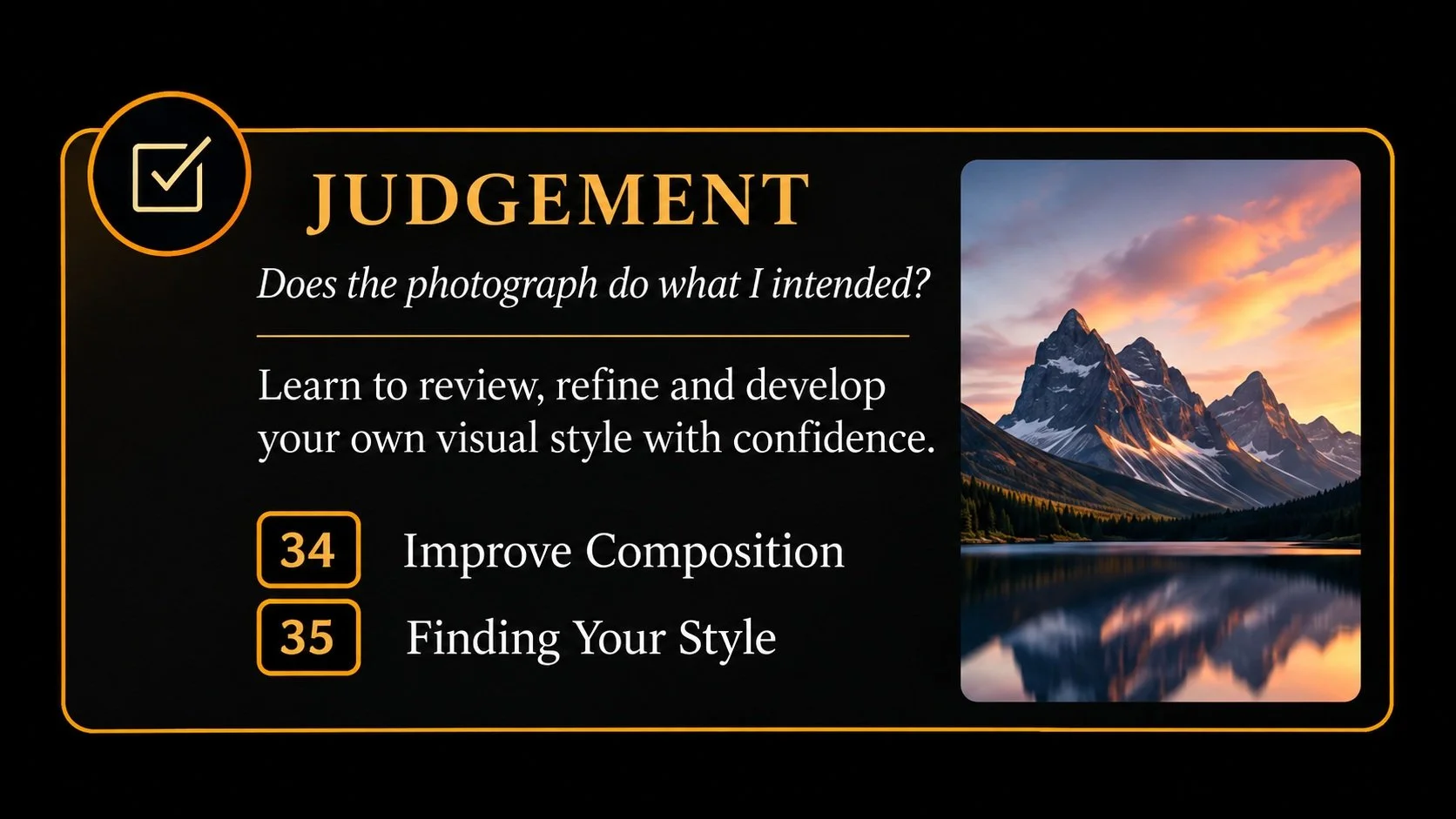
Judgement
Does the photograph do what I intended?
Your focus in Lesson 35: look beyond a single image and assess the decisions that recur across your work. Decide which choices express your interests clearly and which you want to question, refine or explore further.
Video 4 · Judgement
The Judgement group connects the final two composition lessons:
- 34 — Improving Composition: review an individual photograph and decide what to retain, change or practise.
- 35 — Finding Your Style: review patterns across your work and recognise how your visual voice is developing.
Style develops from repeated acts of seeing, responding, choosing and reviewing. It remains connected to every part of the Photography Composition Framework .
HOW STYLE DEVELOPS
Style emerges from a trail of decisions
Style is an outcome of practice. The cycle below connects the four Composition Framework ideas: intention gives direction, restraint removes what weakens it, observation finds evidence and judgement decides what deserves to continue.
Notice
Recognise what repeatedly attracts you.
Choose
Decide what matters and what can be left out.
Make
Use visual and technical choices to communicate it.
Review
Compare intention with the finished photograph.
Select
Keep the work whose decisions remain convincing.
Repeat
Let patterns become visible across time.
Purpose comes first. Camera settings, composition principles and editing choices serve what the photograph needs to communicate. Repeating a technique does not create style unless the decision expresses something meaningful.
Genre, technique, editing and style are different
These ideas can overlap, but confusing them encourages photographers to choose a label or visual recipe before understanding what their work communicates.
Genre
Landscape, portrait, street, documentary and still life describe broad kinds of subject or practice.
You can work in several genres and still make recognisably connected photographs.
Technique
Long exposure, shallow depth of field, intentional camera movement and lighting describe how an image was made.
A technique is useful only when it serves the photograph’s intention.
Editing
Contrast, colour, tone, crop and local adjustments shape the finished interpretation.
A preset can create consistency of treatment without creating a meaningful voice.
Style
Style is the recognisable pattern formed by what you notice, how you organise it, how it feels and what you select.
It appears across a body of work and can evolve without losing coherence.
Do not begin by asking, “Which style should I choose?” Begin with the evidence in your photographs: what decisions recur, why do they matter and what do they help the work communicate?
Four sources of evidence reveal your style
Review a body of work rather than one successful photograph. Look for connections across these four areas, then ask whether they express a genuine interest or have simply become a habit.
What repeatedly attracts you?
Subjects, moments, relationships, ideas and qualities of light that make you raise the camera.
- What do you notice before others?
- Which subjects keep returning?
- What emotional response begins the photograph?
How do you organise it?
Viewpoint, distance, timing, framing, space and the route taken by the viewer’s eye.
- Do you simplify or layer?
- Move close or retain context?
- Prefer balance, tension, stillness or movement?
How should the photograph feel?
Atmosphere, colour, contrast, ambiguity, rhythm and emotional tone.
- Which qualities survive different subjects?
- What do light and colour contribute?
- What is suggested rather than explained?
What do you choose to keep?
Editing, comparison, sequencing, projects and the photographs that remain convincing after time.
- Which images still match your purpose?
- What weakens the relationship?
- What does the sequence reveal?
Style is the relationship between all four. It cannot be diagnosed from subject matter, camera settings or colour treatment alone.
Style becomes visible through connected decisions
These photographs are linked by more than subject matter. They repeatedly turn water into surface, colour, rhythm and ambiguity. Framing removes much of the literal setting; timing and exposure support the experience. That combination of attraction, organisation and feeling is stronger evidence of style than the label “water photography”.
Review the relationship: what is consistent across these photographs, what is allowed to vary and which decisions make the group feel authored rather than mechanically matched?
Experiment to test your direction, not to collect effects
Familiar decisions can reveal style, but they can also become automatic habits. A useful experiment changes one condition while keeping the photographic purpose clear. The result shows whether a choice is essential, optional or merely comfortable.
Keep the purpose
Name what you want the photograph to communicate before changing equipment, subject, viewpoint or technique.
Change one constraint
Work closer, slower, with fewer frames, in different light or with a different relationship to the subject.
Review the evidence
Ask which decision clarified the response, which weakened it and which revealed an interest you had not recognised.
Useful question: if I remove the technique or familiar treatment, does the photograph still express something that matters to me?
Editing and selection
Build coherence without forcing sameness
Editing helps clarify a photograph’s intention and can connect a body of work, but style becomes shallow when every image is forced through one visual recipe.
Sameness
The same crop, colour grade, contrast or preset is repeated whether or not it serves each photograph.
- Treatment becomes the main subject.
- Differences in light and meaning are suppressed.
- Consistency is judged by visual matching alone.
Coherence
Different photographs share purpose, attention, atmosphere or visual relationships while retaining their individual needs.
- Editing strengthens visible evidence.
- Variation supports the subject and sequence.
- Consistency is judged by the work’s intention.
Before applying a familiar treatment, ask: what does this particular photograph need? Then compare the result with the wider body of work and identify what connects them beyond colour or contrast.
A project reveals what repeated attention means
The value of this series is not that every photograph shows bark. Sustained attention changes what becomes visible: structure, damage, colour, rhythm, age and variation. The project creates the conditions for style to emerge through choices and comparison.
Editing matters: six purposeful photographs explain the direction more clearly than forty-five near-duplicates. Remove images that repeat information without deepening the project.
Describe a direction without fixing a formula
A working statement can help you decide what to photograph and how to review it. Keep it practical and provisional. It should describe an interest and a desired response, while leaving room for discovery.
What keeps drawing you back?
Identify a subject, relationship, question or experience rather than a genre label.
- Changing surfaces
- Human traces in landscape
- Quiet relationships
What should the work communicate?
Describe how you want the viewer to encounter the photographs.
- Slow attention
- Tension or uncertainty
- Scale, intimacy or distance
Create enough evidence to compare
Make, print or gather related photographs. Group them, change the order and remove images that weaken the idea.
- Select for purpose
- Sequence for rhythm
- Review after time
Working statement: “I am interested in ________. I want the photographs to communicate ________. I will explore this through ________, while allowing the project to change what I understand.”
Style remains recognisable as the scene changes
Woodland can easily become a record of visual clutter. These photographs move between individual trees, repeated trunks, seasonal colour, mist, pathways and changing viewpoints. What connects them is a consistent way of organising complexity: quiet light, restrained colour, layered space and a route for the viewer’s attention.
Review what survives the variation: scale, viewpoint, colour and subject emphasis change, but quiet light, layered space, restraint and a clear route through the frame keep the photographer’s way of seeing recognisable.
Different subjects can share the same quality of attention
These photographs are connected by restraint, distance, subdued tone and meaningful space. The subject changes, but the relationship to it remains recognisable. This is why style is broader than genre and more durable than one technique.
Look beyond appearance: identify the decisions that create quietness. Which of them could remain relevant in a portrait, street scene or still life?
Four collections, one recognisable way of seeing
Water, bark, woodland and quiet landscape differ in subject, scale and visual problem. What connects them is the photographer’s recurring way of paying attention, organising the frame and shaping an experience. Personal style lives in those repeated decisions, not in the subject label.
Transform the familiar
Surface, light, movement and ambiguity turn a recognisable subject into an experience that rewards slow looking.
Stay with the subject
Close attention reveals material, age, damage and variation. Selection turns repeated observation into a coherent body of work.
Organise complexity
Layered space, visual pathways, restrained colour and quiet light give structure to scenes that could otherwise become cluttered.
Let absence carry meaning
Distance, subdued tone and sparse relationships make space and stillness active parts of the photograph.
The shared visual signature
Conscious and subconscious: some choices are deliberate when the photograph is made; others only become visible when work from different places and different years is compared. Style is the pattern formed by both.
Test for style: remove the subject labels. Which preferences in attention, framing, light, timing and feeling would still identify the photographer?
Use feedback without surrendering ownership
Feedback tells you how another person encountered the photograph. It does not tell you what the photograph must become. Convert opinions into visible evidence, compare that evidence with your intention and make the final judgement yourself.
Receive the response
What did the viewer notice, feel, misunderstand or overlook?
Ask for evidence
Which visible part of the photograph created that response?
Compare with intention
Does the response support, complicate or contradict what you meant?
Choose deliberately
Keep, question or disregard the suggestion — and know why.
Allow style to evolve. A developing style is a living pattern, not a contract with your earlier work. Keep what remains meaningful, question what has become automatic and let new interests change the direction.
Your photography style is already developing
You do not need to invent a persona or decide how every future photograph should look. You need enough evidence, honest comparison and continued practice to recognise the decisions that remain meaningful.
Gather
Collect photographs you still value from different periods and subjects.
Group
Arrange them by recurring attention, organisation, feeling or treatment.
Name
Describe the visible decisions and the purpose they appear to serve.
Test
Change one familiar constraint and see which decisions remain important.
Edit
Remove repetition, sequence related work and protect meaningful variation.
Continue
Use feedback and new projects to refine the direction without fixing it.
Discover Your Default Photography Style
Take a short, no-pressure quiz to see which styles you naturally gravitate toward, plus quick tips to improve your next shoot.
- Which equipment are you most likely to reach for?
A) Portrait lens B) Fast street lens C) Wide-angle D) Telephoto E) Macro
- What scene are you most drawn to?
A) Candid city moment B) Mountain vista C) Portrait with story D) Delicate flower E) Wildlife in action
- What matters most in a great photo?
A) Emotion/story B) Light and composition C) Scale of the scene D) Sharp detail E) Unobtrusive capture
You enjoy telling stories through expression and light. You notice small gestures and work well with people.
- Still Life: 33%
- Street: 17%
- Landscape: 0%
- Master eye focus and catchlights.
- Shape light with a reflector or large modifier.
- Guide micro-posing: hands, shoulders, chin.
Find and Refine Your Photography Style
Download the 1-page field checklist or book live support.
Frequently asked questions
Finding and developing your photography style
These answers explain how photographic style develops through repeated interests, decisions, experimentation and review.
What is a photography style?
A photography style is the recognisable pattern created by the subjects, light, compositions, moments, colours and moods a photographer repeatedly chooses. It also includes how those choices are interpreted through technique, editing and presentation.
How can I find my own photography style?
Gather 30–40 photographs that matter to you and look for recurring subjects, visual relationships, lighting, moods and compositional decisions. Compare those patterns with the experience of making the photographs and note what you want to explore again. The photography style quiz can provide another starting point.
What is the difference between a photography genre and style?
A genre describes the broad type of photography, such as landscape, portrait, wildlife or street photography. Style describes how an individual photographer sees and interprets a subject, so different photographers can work within the same genre and produce very different images.
Should all my photographs have the same style?
No. A recognisable style does not require every photograph to use the same colour palette, lens, composition or editing treatment. Coherence can come from recurring interests, emotional responses and ways of organising the frame while individual photographs remain varied.
How can I develop a photography style without copying others?
Study other photographers to understand possible approaches, then use your own subjects, experiences and intentions to guide your decisions. Experiment with constraints and projects, review the results and retain the choices that communicate something meaningful to you.
Does editing create a photography style?
Editing contributes to style through choices involving tone, colour, contrast, texture and cropping. It cannot replace the decisions made while observing and photographing a scene. A strong editing process supports the subject, atmosphere and intention already present in the image.
How can a portfolio help me identify my photography style?
A portfolio places related photographs together so that recurring subjects, visual rhythms and decisions become easier to recognise. Selecting and sequencing the work also reveals which images support your direction and which feel disconnected from it.
Can my photography style change over time?
Yes. Style naturally changes as your interests, experience, circumstances and understanding develop. Reviewing your work helps you recognise that change and decide which ideas you want to continue, question or explore next.
Composition series complete
Continue reviewing and developing your work
Lesson 35 completes the ten composition lessons. Return to the complete framework whenever you want to review how intention, restraint, observation and judgement work together.
