
Autumn Arboretum & Garden Photography: A UK Guide 2026
Autumn Arboretum & Garden Photography: A UK Guide 2026
Table of Contents Show
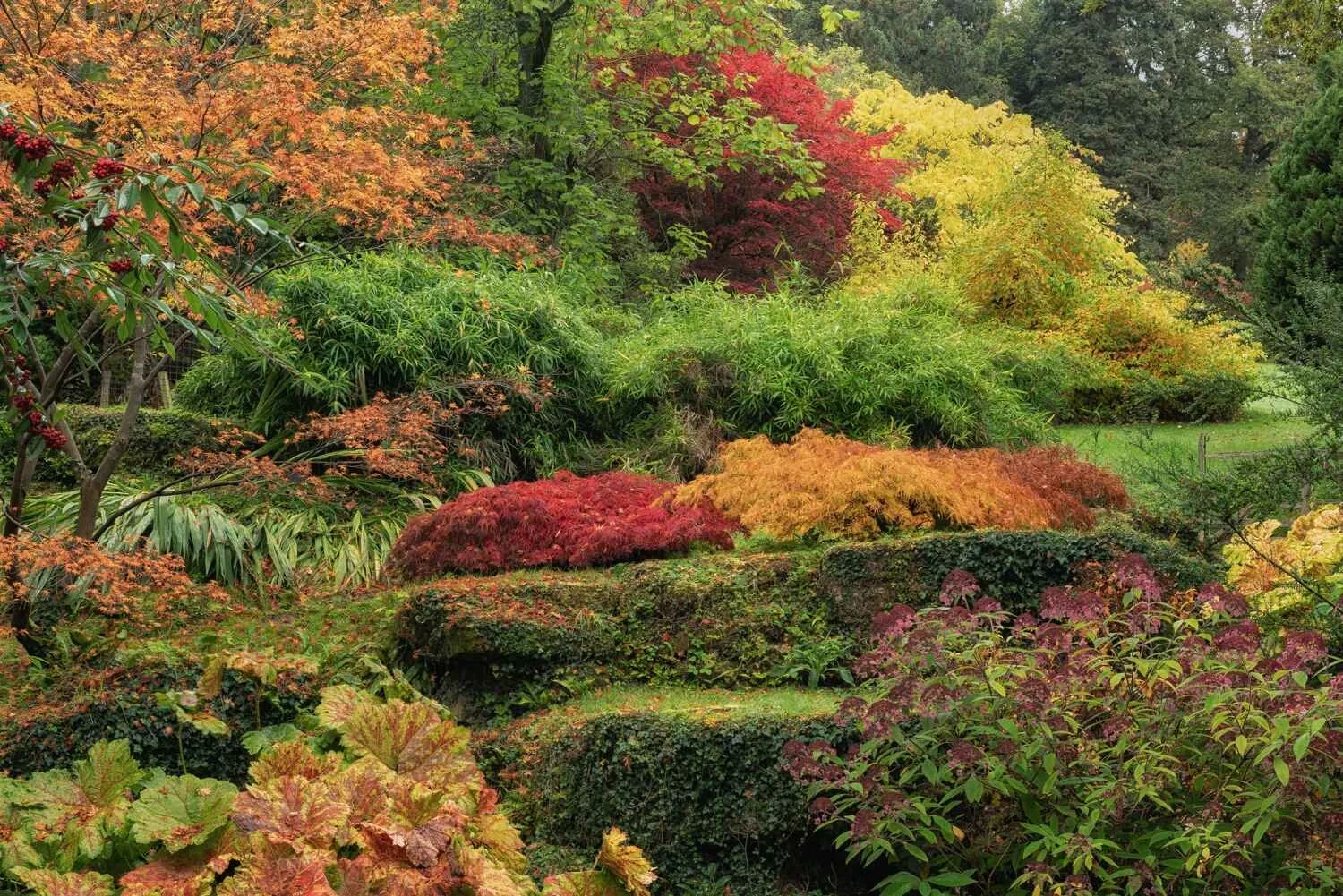
British autumn delivers two distinct photographic environments and most photographers only chase the wild one. Lake District fells, Welsh valleys, Peak District gorges and Yorkshire Dales lanes get the photographic glory each October — and rightly so. But the cultivated environments — UK arboretums and ornamental gardens — offer something the wild landscape can't: curated tree species selected for specific colour displays, planted with composition in mind, accessible by car, and predictable enough to plan around. A morning at Batsford in late October produces a different kind of frame from a morning in Borrowdale, and the photographer who works both is producing a more complete autumn portfolio than the photographer who only chases the wild.
This guide is the cultivated-environment companion to my UK autumn landscape photography guide (which covers wild locations, golden hour, filters, and the broader landscape framework) and my general autumn photography tips. Read those for the wild-landscape and general autumn approach. This article is about the specific decisions that arboretums and ornamental gardens demand: timing peak colour for curated species, the four cultivated shot types, working mixed canopy light, and the workflow for crowded paid-entry locations where you can't simply choose your own moment.
Why arboretums are their own subject
An arboretum isn't a wild woodland with paths through it — it's a curated collection of tree specimens, often imported from across the world, planted with deliberate spacing and lighting in mind. The autumn experience is therefore manufactured: a Victorian or Edwardian plant collector chose a Japanese maple, a North American liquidambar, a Chinese ginkgo, a European beech, and arranged them so that the colour displays peak in succession across late September, October, and into early November. Photographing this is a different problem from wild woodland.
The advantages are substantial. Specimen trees are widely spaced, allowing full-tree compositions impossible in dense wild woodland. Species diversity means a single visit can include reds, oranges, yellows, golds, and surviving greens within walking distance. Pathways make access easy. Most arboretums have parking, cafes, and toilets — sustained sessions become practical in a way wild locations rarely allow.
The disadvantages are also real, and most amateur arboretum photography fails to manage them. Visitor density at peak colour weekends is intense — Westonbirt and Batsford both run timed-entry tickets through autumn. Pathways, fences, signs, benches and other photographers are constant background-clutter problems. Mixed canopy light shifts faster than even forest light because specimens are widely spaced and gaps between trees are larger. Direct sun on individual trees can produce harsh contrast a wild woodland's even canopy avoids. Working an arboretum well requires the same intermediate decision discipline as a tide-led seascape or a polariser-led waterfall — not just better composition, but better timing, better light reading, and better visitor avoidance.
Peak colour timing: the UK arboretum calendar
Autumn doesn't arrive at a single moment. Different species peak in different weeks across a six-to-eight-week window from mid-September into early November. Knowing which species you want, when they peak, and how recent weather has affected the timing is the first decision of arboretum photography — the equivalent of tide reading for seascape work. For the broader seasonal framework, see my mastering seasonal photography piece.
Three rules for UK arboretum colour timing:
Sustained cool nights drive colour. The shift from green chlorophyll to yellow, orange and red carotenoids and anthocyanins is triggered by sustained cool nights (5–10°C) combined with bright daylight. A warm October delays peak colour; a cold mid-September accelerates it. Watch the ten-day forecast — a sequence of cool nights five to ten days out is a strong signal that peak is approaching.
Different species peak in different weeks. Japanese maples (acers) tend to peak late October to early November and are the headline species at most UK arboretums. Liquidambars (sweet gums) often peak late October. Ginkgos peak late October to mid November and turn pure yellow before dropping all leaves rapidly. Native beech peaks mid October. Oaks peak late November and hold longer than most. The same arboretum visited two weeks apart is a different photograph.
Weather windows matter as much as date. A wet calm day after sustained dry weather is ideal — wet leaves saturate colour and water on bark adds tonal depth. A dry windy day shortly before peak strips leaves from branches and ends the photographic window early. Plan around weather, not around weekends.
UK arboretum species peak-colour calendar — different species peak in different weeks, so the same arboretum visited two weeks apart is a different photograph. Watch the weather as much as the calendar.
The four cultivated shot types
Every strong arboretum or garden autumn photograph fits one of four shot types. The decision of which to pursue, made before the day, drives lens choice, light expectation, and what counts as a keeper. Same framework as the seascape and waterfall articles in this series — pick one shot type, commit to it, save the others for next visit.
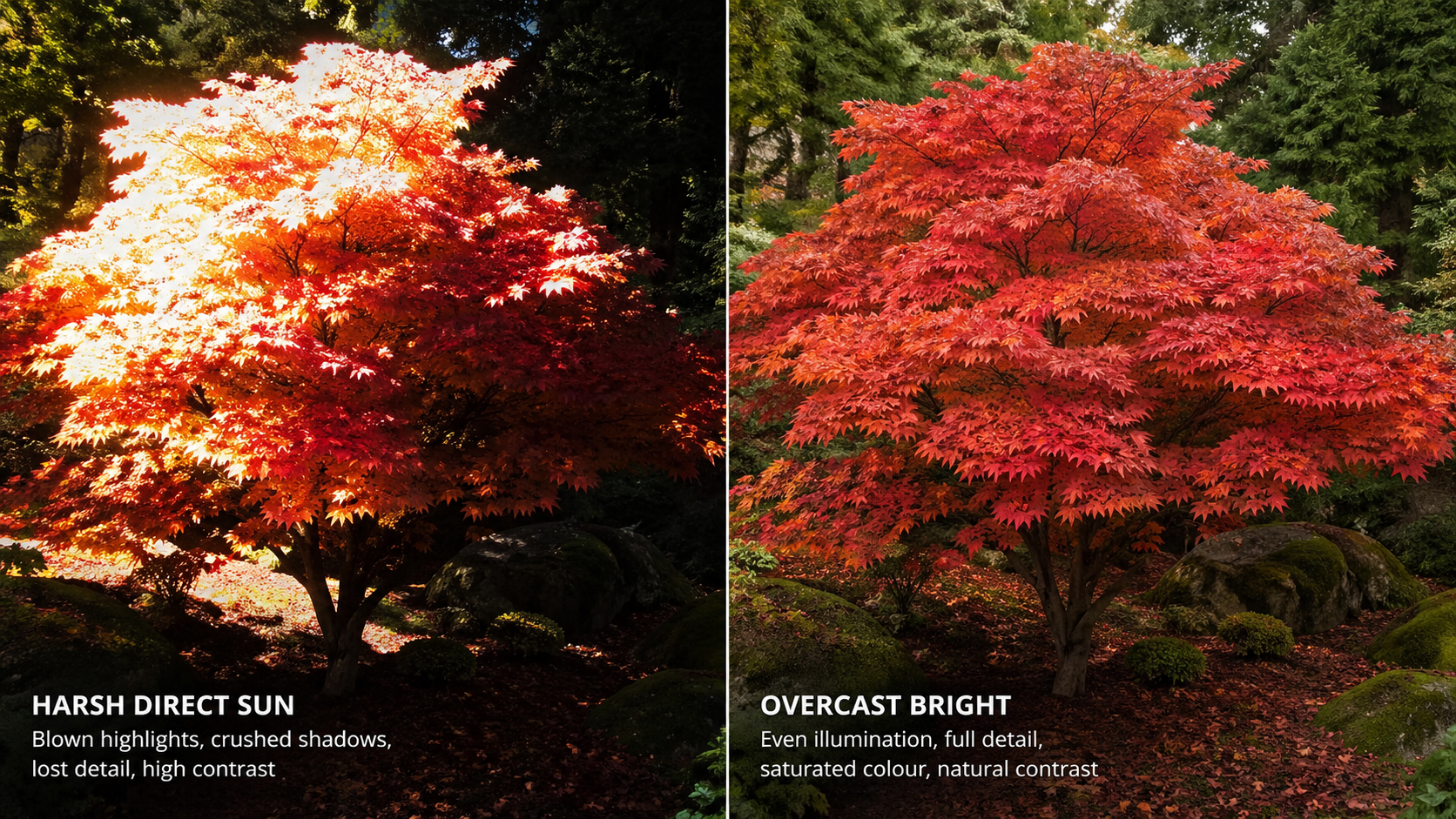
The full-tree colour study. Wide composition isolating a single specimen tree at peak colour against a clean background — sky, lawn, or a contrasting darker tree behind. Standard zoom (24–70mm) or short telephoto, polariser, exposure 1/60 to 1/250 second. The signature arboretum shot. Works best in soft overcast light or shaded morning, fails in harsh direct sun.
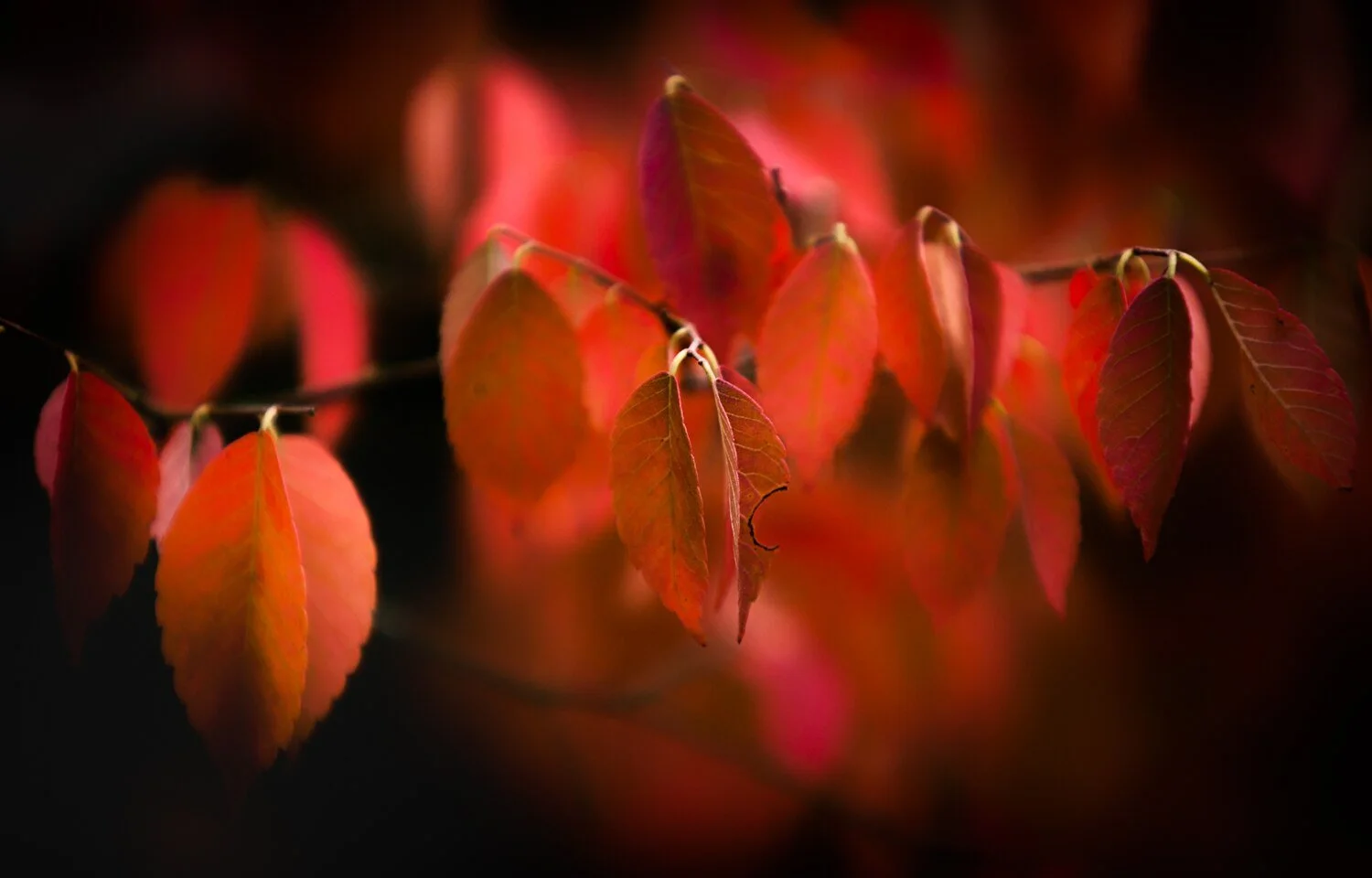
The intimate leaf detail (macro). Telephoto or macro lens close on a single branch, leaf cluster, or fallen-leaf grouping. The shot type that produces the most prints because nobody else has that exact frame. Calls on the same technique as my macro photography guide. Polariser, f/4 to f/8 depending on depth-of-field choice, 1/125 to 1/500 second to freeze any breeze movement.
The woodland-floor carpet. Looking down or low-angle composition emphasising fallen leaves as a textured colour carpet, often with a tree trunk anchoring the frame. Standard or wide-angle lens, polariser to cut leaf glare, mid-aperture (f/8) for full carpet sharpness. Works best in even overcast light. The shot type that comes good in the days after peak when most photographers have already gone home thinking the season is over.
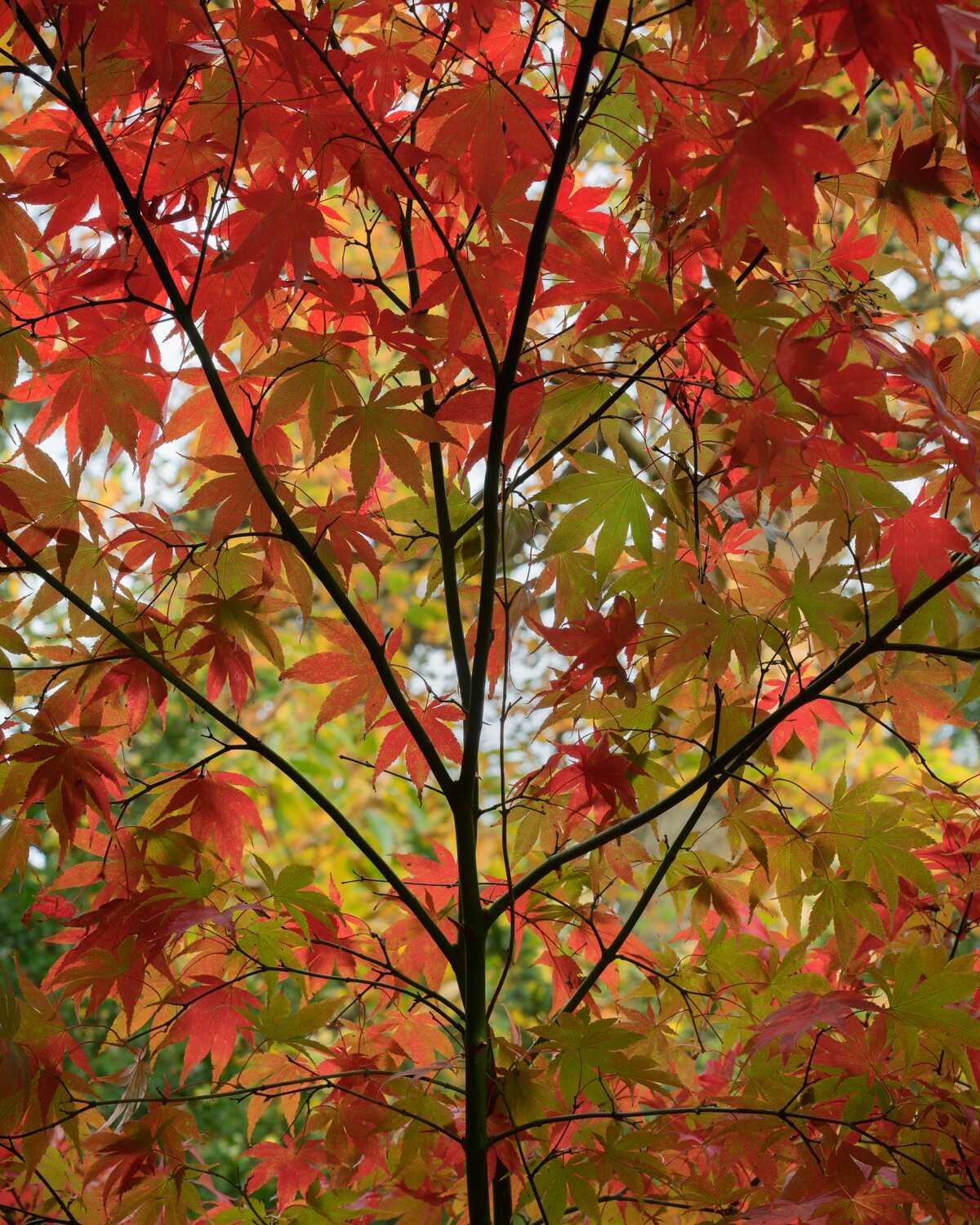
The light-through-canopy backlit. Camera positioned so that low-angle morning or late-afternoon sun is filtering through the canopy directly toward the lens. Leaves become translucent, glowing with internal colour rather than reflected light. Telephoto compresses the effect. The most graphically dramatic shot type but the one that requires the most precise timing — works for maybe 30 minutes in the right week of the right month at the right location.
Composition is harder in cultivated environments than in wild ones because the man-made elements (paths, fences, signs, benches, other visitors) compete for attention. Strong arboretum frames usually have those elements either fully composed in (deliberate) or fully composed out — the half-cropped fence in the corner of an otherwise good frame is the most common amateur tell. For composition discipline see my photography composition rules article.
Cultivated autumn settings by shot type — starting points, not absolute rules. Pick the shot type before you arrive; bracket around these values for the specific scene and light.
Working mixed canopy light
Cultivated arboretums have a specific lighting problem that wild woodlands don't. Specimens are widely spaced, so canopy gaps are large and frequent. Light shifts faster between full sun, dappled light, deep shade, and rim-lit transitions than even-canopy forest light does. A photograph composed in deep shade three minutes ago might now sit in harsh direct sun, then shift back. Three working approaches:
Use overcast bright as your default. Soft even cloud removes the light-shift problem entirely. Most professional arboretum work happens on overcast bright days for exactly this reason. Direct sun on a Japanese maple at peak colour is photogenic for thirty seconds and unmanageable for the next four minutes — overcast bright is photogenic for the whole afternoon.
Work edges, not centres. The edges of canopy gaps — where lit foliage meets shaded foliage — are where the strongest backlit shots and the most graphic compositions live. The flat-lit centre of a path under canopy is photographically dull regardless of how good the trees are.
Polariser always. Same logic as the waterfall article — the polariser cuts wet-leaf glare, deepens autumn colour saturation, and reduces specular highlight from any wet ground. Even in dry conditions a polariser makes a measurable difference to autumn colour rendering. Stack with a 3-stop ND if you want to push exposure into the slow-shutter range for falling-leaf or breeze-blur effects.
Beating the crowds
The single biggest determinant of arboretum photography success is whether other people are in your frame. At Westonbirt or Batsford on a peak-colour Saturday, the public footpaths around the headline acer collection are continuous-stream busy from opening until close. Photography around a constant flow of visitors is possible but limits your composition options to those without a clear background.
Three strategies for managing visitor density:
First hour after opening, last hour before close. Most visitors arrive between 11am and 3pm. The first hour after opening (typically 9am or 10am) and the last hour before close (typically 4pm or 5pm) are dramatically quieter. Combined with low directional light, these are the best photographic windows of the day.
Weekday over weekend. The visitor difference between a peak-colour Saturday and a peak-colour Tuesday is roughly 4:1. If you have any flexibility, weekday visits are genuinely transformative for productive shooting time.
Pre-opening workshop access. A few UK arboretums grant exclusive workshop access before public opening. My Batsford Arboretum autumn photography workshops include access from 8am — a full hour before public opening — when no other visitors are in the arboretum. Combined with the directional first-light hour, this is by some distance the most productive photography window the location offers, and one of the few ways to photograph headline arboretum locations without managing crowds.
I've run autumn workshops at Batsford for over ten years and taught more than five hundred photographers there across that time. The 8am exclusive access is the single feature attendees comment on most often after the workshop — not the teaching, not the colour, but the experience of having one of the UK's headline autumn arboretums to themselves for an hour at first light.
The arboretum shoot workflow
The workflow that produces consistently strong arboretum and garden frames combines weather-led timing, shot-type commitment, mixed-light awareness, and visitor-density management. Six steps from the week before to editing.
See a UK woodland photographer at work in autumn
The video below — "Autumn Woodland Photography - Be Prepared" by Simon Baxter on the Simon Baxter channel — is filmed in private oak woodland in North Yorkshire and centres on the preparation phase of autumn photography: scouting locations, reading the canopy, anticipating colour. Although Simon's video is wild rather than cultivated, the preparation framework translates directly to arboretum work — the more you know about what's there before you raise the camera, the better the frames you come home with. Simon is widely regarded as one of the world's leading woodland photographers and the first dedicated woodland photographer on YouTube. About 20 minutes and worth watching the week before any serious autumn shoot.
UK arboretum location framework
Six UK arboretums and ornamental gardens deliver the bulk of strong autumn photography opportunities. Each has its own character, headline species, and access profile.
Batsford Arboretum (Cotswolds, Gloucestershire). 60 acres, around 2,850 specimens including the national Japanese flowering cherry collection, strong oriental focus on maples and bamboos. Peak window late October to early November. Easy parking and cafe. My Batsford autumn workshops run daily across late October with 8am exclusive access. See also the Batsford workshop landing page.
Westonbirt — The National Arboretum (Gloucestershire). 600 acres, over 15,000 trees and shrubs, holds the national maple collection. Acer Glade is the headline location at peak. Timed-entry tickets essential at peak weekends. Forestry England management. Larger and more visitor-heavy than Batsford.
Sheffield Park Garden (East Sussex). National Trust, designed by Capability Brown, lake reflections of autumn colour are the headline shot. Mid October to early November.
Bodnant Garden (Conwy, North Wales). National Trust, terraced gardens with strong acer collection, dramatic Welsh hill backdrop. Mid October to early November.
Stourhead (Wiltshire). National Trust, 18th-century landscape garden with lake and follies, autumn reflections in the lake are the iconic frame. Late October to early November.
Yorkshire Arboretum (Castle Howard estate). 120 acres, planted from 1970s with global expedition specimens. Less crowded than Westonbirt or Batsford and quieter for serious work.
For creative project ideas adaptable to any of these locations, see my five creative autumn photography projects — most translate directly to arboretum environments and provide variation across multiple visits to the same location.
Common autumn arboretum mistakes
Visiting one week too early or one week too late. The peak colour window is narrower than amateur photographers expect — often as little as 7–10 days at any given location for the headline species. Watching the colour reports (Westonbirt and Batsford both publish weekly autumn updates on their websites) saves wasted journeys.
Visiting at midday on a Saturday. Already covered — the worst possible combination of light and visitor density. First or last hour of any weekday is dramatically more productive.
Shooting only the headline species. Acers and maples get all the social media attention, but ginkgo collections (pure yellow), liquidambar (deep crimson and purple), and even the surviving greens of late-season conifers all produce stronger photographs at certain moments than the obvious red maples that everyone else is photographing.
Skipping the polariser. Same lesson as waterfalls — the polariser cuts leaf-surface glare and deepens autumn colour saturation in ways post-processing can't fully recover. Always fitted, always rotated, even on overcast days.
Ignoring composition discipline. Cultivated environments mean man-made elements in every frame — paths, fences, signs, benches, visitors. Either deliberately compose them in or deliberately compose them out; half-cropped intrusion is the most common amateur tell.
Editing colour up rather than holding it back. Autumn colour is already saturated by the polariser and by RAW processing defaults. Pushing saturation further produces the orange-clipped over-cooked look that dates a frame faster than any other processing choice. Restrained colour grading produces frames that age well.
Stopping when the headline species has dropped. The week after peak — when oaks, beeches, and the late-dropping ginkgos are still going while maples have already shed — is one of the most underrated photographic windows of the autumn calendar. Carpets of fallen leaves on the woodland floor produce a completely different shot type that's only available after peak.
Autumn arboretum photography FAQ
Key takeaways
Timing is the first decision — sustained cool nights drive colour, different species peak in different weeks, weather windows matter as much as the calendar date.
Pick one of the four shot types per visit — full-tree colour study, intimate leaf detail, woodland-floor carpet, light-through-canopy backlit. Trying all four gets you none.
Overcast bright is the gold-standard light — direct sun on individual specimens produces blown highlights and harsh contrast unmanageable in the time-windows arboretums offer.
Polariser always — cuts leaf glare, deepens autumn saturation, often eliminates need for ND in normal conditions.
Beat the crowds — first or last hour, weekday over weekend, exclusive workshop access where available. Visitor density is the single biggest determinant of productive shooting time.
Compose man-made elements deliberately — fences, paths, signs, benches either fully in or fully out. Half-in is the most common amateur frame failure.
Don't stop at peak — woodland-floor carpet shots and late-species (ginkgo, oak, beech) frames are available in the days after most photographers have packed up for the year.
Continue learning
Conclusion and summary
UK autumn arboretum and garden photography rewards intermediate decision discipline more than equipment, location celebrity, or processing skill. The cultivated environment offers what wild woodland can't — curated species selected for colour displays, predictable access, and concentrated diversity within walking distance — but demands what wild woodland doesn't: weather-led timing for narrow peak windows, visitor-density management at headline locations, mixed-canopy light reading, and deliberate composition around man-made elements. The photographers who come home with prints they're proud of are the ones who watched the colour reports the week before, picked overcast bright over Saturday-direct-sun, committed to one of the four shot types per visit, and arrived at first hour or last hour rather than the visitor-peak middle of the day.
The framework to internalise: timing first, shot type second, polariser-always-fitted, work the edges of canopy gaps, beat the crowds. Four shot types cover the genre — full-tree colour study, intimate leaf detail, woodland-floor carpet, and light-through-canopy backlit. Six UK arboretums (Batsford, Westonbirt, Sheffield Park, Bodnant, Stourhead, Yorkshire Arboretum) deliver the bulk of strong opportunities, each with its own headline species and peak window. The week after peak is genuinely productive — carpet shots and late-species frames remain available when most photographers have packed up. Restrained colour grading in post produces frames that age well; pushed saturation produces the cliché orange-clipped autumn look that dates a portfolio.
If you'd rather learn this framework on a specific UK arboretum at peak colour with exclusive 8am access before public opening, my Batsford Arboretum autumn photography workshops run daily across late October — half-day or full-day options, maximum six photographers per session, suitable for any level of experience. The exclusive pre-opening access is the single most-mentioned feature in attendee feedback after the workshops finish: photography in one of the UK's headline autumn arboretums without the crowd-management problem that defines normal visiting hours. Workshop attendees also get the location-specific knowledge of where to be at which time of day to make best use of light direction across the 60-acre site, built up over more than ten years of running these workshops in this specific location. For everything else, your nearest National Trust or arboretum, watching the colour report the week before, weekday morning or afternoon, polariser fitted, plus the four-shot-type framework above is more than enough to come home with frames you'll actually want to print.