
What Is FRAMING in Photography? A Craft, Not a Rulebook
Updated 11 June 2026
Table of Contents Show
What framing really means
Framing is one of those words in photography that gets reduced to a single trick — shoot your subject through a doorway or a gap in the branches and call it done. But framing is far bigger, and far more useful, than that. It's the craft of deciding what belongs inside your four edges, what to leave out, and how everything you keep works together to lead the eye where you want it. Get that right and a photograph holds together; get it wrong and no clever border will save it. This guide is about learning to see it.

Ask most people what “framing” means in photography and they’ll tell you the same thing: find a doorway, an arch, or some overhanging branches and shoot your subject through the gap. It’s on every beginner blog and in every composition-tips list.
It isn’t wrong. But it’s one small trick, and the trouble with starting there is that it turns framing into a hunt for gimmicks — you end up looking for archways instead of looking at your picture. In my experience teaching photographers, that frame-within-a-frame works perhaps one time in five, and even then only because it happens to be doing the deeper things good framing always does.
Because real framing isn’t a rule, and it certainly isn’t a checklist. It’s a craft. It’s learning to see whether everything inside your four edges is working together or pulling apart — and then trusting your feel for it. Some of what follows are close to firm habits worth building early. Most are softer than that: guidelines you’ll lean on while your eye develops, and then bend, stretch or deliberately break once you understand why they’re there. That last part matters. The point isn’t to obey these. It’s to know them well enough to choose.
Framing is a decision, not a trick
Your camera draws a rectangle around the world. Framing is every choice you make about that rectangle: where the edges fall, what sits inside them, what you leave out, and how the things you keep relate to one another. The frame-within-a-frame is just one of those choices, and a minor one. The things that really decide whether a frame holds are quieter, and you feel them as much as you see them.
The table below sets out the things worth looking at. Read the last column carefully: it tells you which are close to firm habits and which are softer guidelines you’ll learn to bend.
Start with the subject
Every photograph wants one clear thing to look at. Before anything else, decide what that is. If you can’t say it simply — “this is a photograph of the lone tree” — the viewer won’t know where to look either. This is the closest thing to a firm rule here, and it’s worth building as a habit early: know your subject before you press the shutter. Everything after this is in service of it.
It doesn’t mean every photograph has a single obvious hero — as you grow you’ll make pictures that are deliberately ambiguous, or about a mood rather than a thing. But you learn that by first learning to make the subject clear. Break the rule when you mean to, not by accident.
Make sure the subject wins
Knowing your subject isn’t the same as the subject winning. The eye goes to the loudest thing in the frame — the brightest, the sharpest, the most saturated — and that isn’t always what you care about. A bright patch of sky in a corner, a vivid sign behind your subject’s shoulder, can quietly steal the picture.
So the question to keep asking, gently, is: is my subject the strongest thing here, or is something else shouting over it? If something’s stealing the eye, you have choices — move, recompose, throw it out of focus, wait for it to pass, or change your exposure so the subject holds the attention. You don’t always have to win this outright. Sometimes a little tension between subject and surroundings is what makes the picture interesting. But you want it to be your choice, not an accident you didn’t notice.
Check the edges
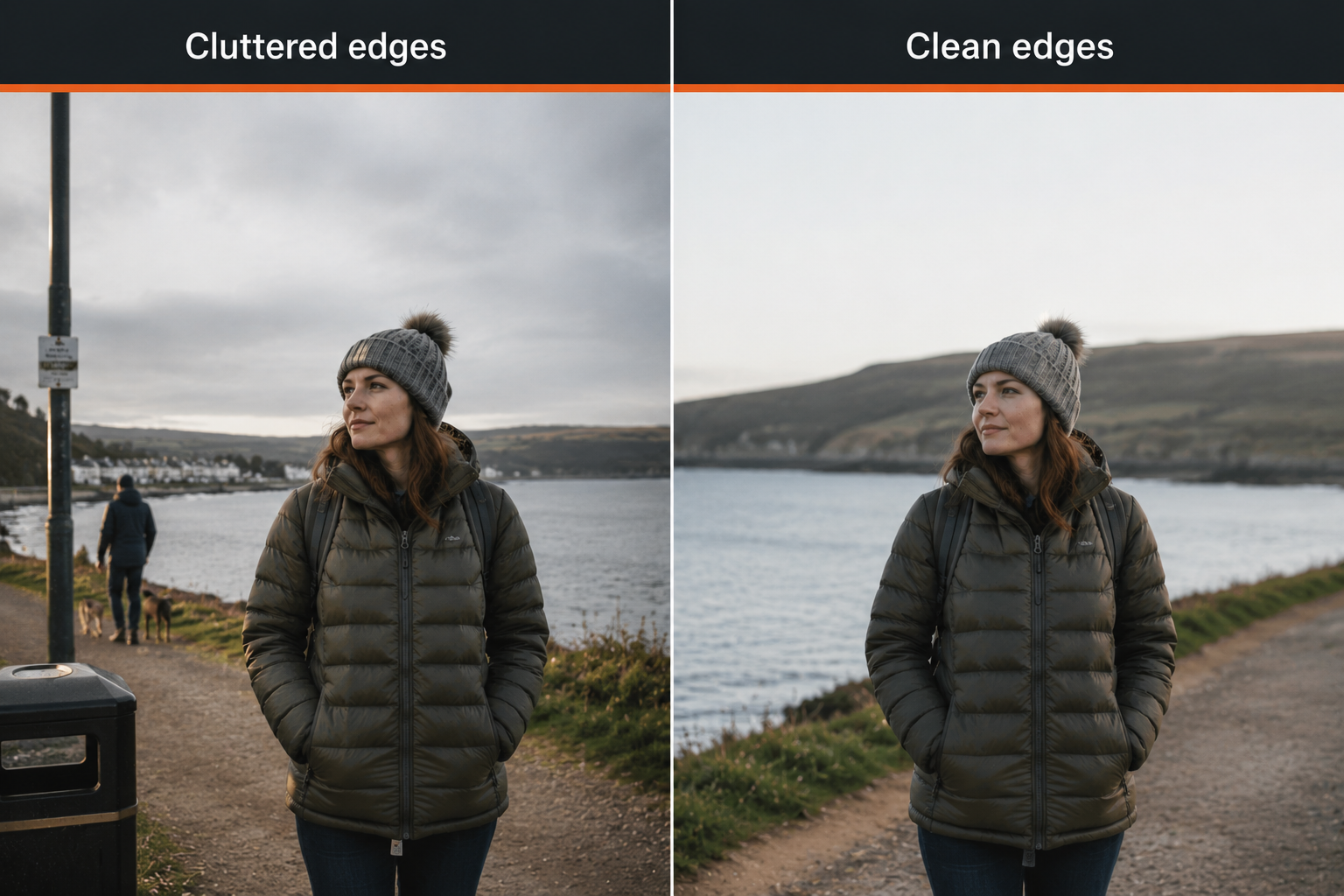
This is the single most useful habit I teach, and the one beginners skip most. Before you press the shutter, run your eye round the whole edge of the frame — all four sides — and see what’s there. You’re looking for the things that quietly weaken a picture: a background object that seems to grow out of your subject (the classic lamp post “sprouting” from a head); a bright distraction near a corner that tugs the eye off the edge; a person, car or tree clipped awkwardly by the frame, neither in nor out.
Most weak photographs aren’t weak because of what’s in the middle. They’re weak because of what was allowed to creep in at the edges. A step to the side, a slight change of angle, a small zoom, or just waiting a moment will usually clean it up — and it’s far better done now than in editing later. Of everything on this page, edge-checking is the one I’d push you to make automatic. It’s less about taste and more about not undermining yourself.
Feel the balance
Every element in a frame has a visual “weight” — a pull on the eye. Bright is heavier than dark, large heavier than small, sharp heavier than soft, a face heavier than almost anything. Good framing arranges those weights so the picture feels settled rather than tipping to one side.
This is where you move firmly from rules into feel. Balance doesn’t mean symmetry, and it doesn’t mean centring everything — a picture can be heavily weighted to one side and feel completely right. A simple test while your eye develops: half-close your eyes until the scene blurs into patches of light and dark. That blur is your balance. If it looks lopsided as a blur and you didn’t intend it, it’ll feel lopsided as a photograph. But “lopsided” is sometimes exactly what you want — tension, unease, a lot of empty space on one side. Once you can feel balance, deliberate imbalance becomes one of your most expressive tools. Learn the settled version first so the unsettled one is a decision.
Watch for breaks
Related to balance, but worth its own glance: look for any harsh break in tone, contrast or colour that pulls attention away from your subject. A slash of bright sky cutting into a calm scene, a hard dark shape intruding at the edge, a clash of colour in the wrong place — any of these can fracture an otherwise quiet frame and drag the eye to the wrong spot. Again, not a rule — strong breaks are sometimes the whole point of a picture. But notice them, and ask whether each one is working for you or against you.
Lead the eye in
Once the subject is clear and the frame feels balanced, think about how the viewer gets to the subject. The eye doesn’t land on a photograph at random — it enters, usually from an edge or a strong element, and travels along whatever pathways the picture offers: lines, edges, runs of light, repeated shapes, the direction a person is looking.
Your job, when it helps, is to make those pathways lead towards your subject rather than away from it or off the edge. This is where the famous “leading lines” actually belong — not as a rule to bolt on, but as one kind of pathway among many. A path, a fence, a river, a fall of light can all carry the eye inward and make the subject feel like the place the picture was always heading. You won’t always want an obvious route in — sometimes you want the viewer to wander, or to be made to search. That’s fine. Pathways are a tool for guiding attention, not a box to tick. The next module, on leading lines, takes this one pathway type further.
Let everything else support, not steal
Everything in the frame that isn’t the subject is a supporting element — foreground, background, secondary objects, props. The question for each is simple: is it helping, or is it just there competing for attention? A supporting element earns its place if it adds context, adds depth, strengthens a pathway, or helps the balance. If it does none of those and is simply clutter, deal with it — move, hide it, soften it, or frame it out. Beginners almost always include too much. The strongest photographs usually hold less than you’d expect, not more. This isn’t a rule so much as a discipline of attention: keep asking what each thing is doing there, and be willing to lose it if the answer is “nothing.”
And the frame-within-a-frame?
Use it when it genuinely helps — sometimes it does. A doorway or a gap in the foliage can add depth, lead the eye, and give a sense of looking into a scene. When it works, it works because it’s quietly doing the real jobs above. Just don’t let the hunt for a convenient arch override a strong subject sitting right in front of you. It’s one option in a deep toolkit, not the headline.

From checks to instinct
When you’re starting out, you’ll run through some of this consciously — what’s my subject, are the edges clean, does this feel balanced. That’s normal, and it’s worth doing. But the aim isn’t to carry a checklist into the field forever. With practice these stop being questions you ask and become things you simply see: you’ll feel when a frame is cluttered or off-balance the moment you raise the camera.
And that’s the real reason to learn them. Not so you can obey them — so that when you choose to leave a distraction in, tip the balance hard to one side, or hide your subject in the noise, you’re doing it on purpose, because you can feel exactly what you’re trading and why. Rules you’ve absorbed are the ones you get to break well. That’s framing as a craft — and it’s where your own way of seeing starts.

Key takeaways
Framing is the craft of controlling everything inside your four edges — not the trick of shooting through doorways and arches.
Start with a clear subject and protect it: it should be the strongest thing in the frame unless you decide otherwise.
Checking the edges for mergers, bright distractions and half-cut objects is the one habit worth making automatic.
Balance, tonal breaks, pathways and supporting elements are matters of feel — guidelines to develop an eye for, not hard rules.
Learn the rules so you can break them deliberately; with practice the conscious checks become instinct.
Conclusion and summary
A well-framed photograph isn’t one with a clever border around the subject. It’s one where the subject is clear, the edges are clean, the weight feels balanced, and everything else is there to help. Those things start as conscious checks and become instinct — and once they’re instinct, you’re free to bend or break any of them on purpose. That is the whole craft of framing, and it’s available in every photograph you take, with or without a tree branch in sight.
If you’d value an experienced eye on your own composition — what’s working, what’s pulling the frame apart, and how to see it for yourself — that is exactly what my one-to-one mentoring is built around. Whichever way you learn, keep making pictures: the eye develops by seeing, not by memorising rules.